Virgin and Child
Bartolomé Estebán Murillo · 1670s
Explore the painting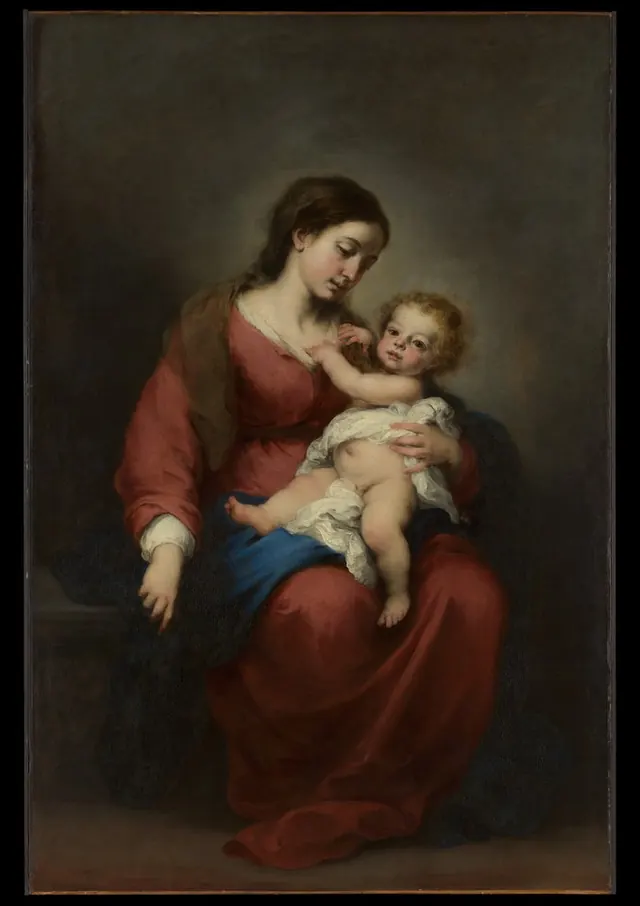
The child in Mary’s arms turns toward the viewer, as though briefly distracted from nursing. Murillo painted this work in the 1670s in Seville, where he spent his career. A familiar Catholic subject centers on a momentary everyday movement. Sacred figures become approachable through an experience of childcare accessible beyond theological learning.
The child’s face receives softer light than the white cloth beneath him. Small shifts of pink, golden, and gray tones round the cheeks. There is little sharp contour. Gradual transitions place the head within the picture’s shared atmosphere and lend the turn toward the viewer an unforced appearance.
Mary inclines her head toward the child. Her attention remains within the group while his gaze turns outward. These different directions connect the viewer to their closeness without making both figures equally frontal. She holds the infant as he momentarily notices something beyond her embrace.
The infant’s hand touches Mary near the neck, establishing bodily contact between them. No separate symbolic object mediates their connection. The child’s weight, the supporting hand, and the proximity of the faces form an intelligible action on which Murillo builds the devotional encounter.
Pale cloth gathers beneath the child’s body, emphasizing its weight and separating skin from Mary’s red clothing. Folds are painted more broadly than the face. This distinction concentrates detail on human contact while allowing other parts of the figure to gather into larger masses of color.
Mary’s lowered hand lies beside the broad blue mantle. Farther down, the figures gradually recede into shadow, while their upper bodies remain illuminated. Murillo provides little information about a room. Attention to mother and child is sustained by the scarcity of external circumstances competing with their movement.
A copy of this painting was known to Cristóbal de Villalpando in Mexico City. He incorporated these figures into works for the cathedrals of Mexico City and Guadalajara. The intimate relationship of mother and child thus entered other, more complex ecclesiastical compositions. An image crossed the Atlantic and acquired a new purpose through another painter’s choices, changing scale and audience through adaptation.
- Medium
- Oil on canvas
- Collection
- The Metropolitan Museum of Art
- Dimensions
- 165.7 × 109.2 cm
- Accession number
- 43.13
Sources
Image provided under CC0. Image licence