Landscape with Saint John on Patmos
Nicolas Poussin · 1640
Explore the painting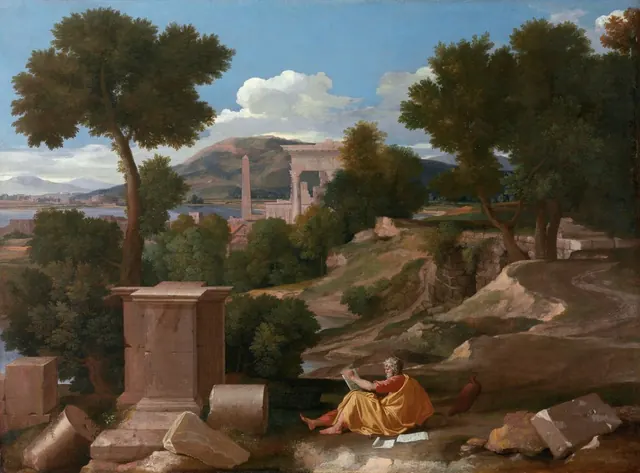
John sits writing among ruins, nearly absorbed by a large landscape. Christian tradition associates Patmos with his Revelation and its visions of the end of time. Poussin painted the scene in 1640, giving the setting remarkable order. The tension between that text and the surrounding calm asks how revelation might be represented through an intelligible natural world.
The saint appears as an elderly man in red and yellow. Loose sheets lie nearby, and an eagle, his traditional attribute, stands behind him. Poussin concentrates on writing. Visions remain outside the canvas while the human activity that turns them into a text becomes visible.
Broken columns surround John. Geometric fragments establish a ruined classical culture in the foreground. A Christian author works among its material remains. The encounter can suggest a change of historical eras or thought continuing within inherited forms.
A tall tree on the left balances the dense canopy on the right. Nature acquires architectural discipline. French-born Poussin spent most of his career in Rome, where ancient art formed part of his daily surroundings. Proportion and the distribution of masses govern this landscape.
A temple and obelisk appear in the distance. Recognisable antique motifs construct an idealised setting. For Poussin’s educated audience, these forms joined religious history to knowledge of antiquity. Cultural memory organises the landscape alongside trees and water.
Stones at the lower edge feel close and substantial. Trees, buildings and mountains follow beyond them. Poussin reduces detail as distance increases. We can trace a route from John’s position towards the horizon. Such a legible landscape differs strikingly from the troubling visions associated with Revelation.
A path on the right passes between masonry and trees, linking the saint’s location with a distant world. John is secluded, but the environment retains human traces. Solitude accommodates reflection while ruined structures preserve history’s presence.
The painting may have belonged to a proposed series of four evangelists; its companion Saint Matthew landscape survives in Berlin. The complete original plan remains uncertain. Patmos here brings Christian revelation alongside a classical ideal of rational order. Their agreement is constructed by the painter and itself invites reflection.
- Medium
- Oil on canvas
- Collection
- Art Institute of Chicago
- Dimensions
- 100.3 × 136.4 cm
- Accession number
- 1930.500
Sources
Image provided under CC0. Image licence
Adapted and translated from Art Institute of Chicago materials. · Text licence