The Coronation of the Virgin
Annibale Carracci · after 1595
Explore the painting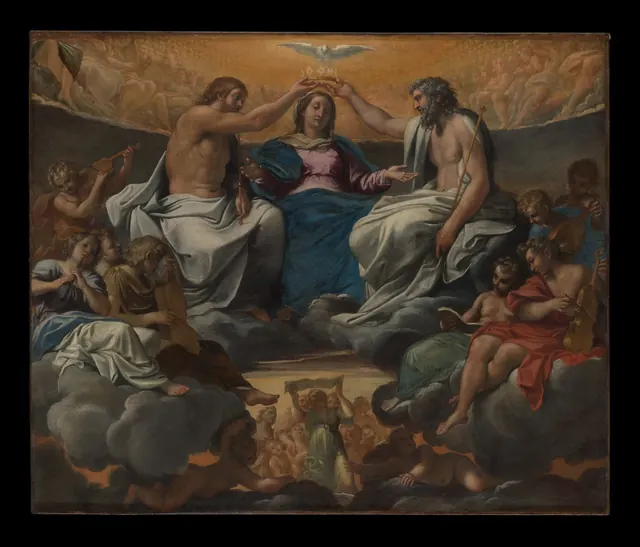
Annibale Carracci painted the Coronation of the Virgin shortly after arriving in Rome in 1595, for Cardinal Pietro Aldobrandini. The heavenly ceremony joins a religious patron’s interests to the Bolognese painter’s new Roman experience. Carracci studies Raphael and ancient sculpture while retaining a northern Italian sensitivity to light and color.
Mary bows her head between Christ and God the Father. She opens her hands, and her body occupies a stable central position. The coronation is expressed through the almost familial proximity of three figures. Coordinated gestures and the space around them give the ceremony dignity.
The crown is above the bowed head, with the dove of the Holy Spirit higher still. Christ, the Father, and the dove represent the Trinity. The act of coronation and its theological basis share one vertical axis. Mary’s elevation takes place within a heavenly order.
God the Father at the right draws on an ancient statue of Jupiter. The imposing male figure of Roman art enters a Christian image. For a cardinal and his circle, knowledge of antiquity could enhance a religious painting’s value. Ancient art entered ecclesiastical patronage as an artistic authority.
Christ at the left turns toward Mary, continuing the group’s curved arrangement. Bodies possess weight yet rest on clouds. Carracci combines physically convincing figures with a setting impossible on earth. The heavenly event becomes imaginable as something close and visible.
Angels below fill the clouds with movement and music. Their varied turns extend the ceremony beyond the central trio. The lower area is lively while the upper group retains clarity. This controlled variety presents a celebration encompassing a whole heavenly assembly.
The painting shows religious patronage supporting artistic renewal. A Christian heaven is shaped through an ancient god, Raphael’s example, and observation of illuminated bodies. A cardinal’s patronage joined faith to learned collecting. Innovation emerged within this setting through a flexible combination of established artistic models.
- Medium
- Oil on canvas
- Collection
- The Metropolitan Museum of Art
- Dimensions
- 117.8 × 141.3 cm
- Accession number
- 1971.155
Sources
Image provided under CC0. Image licence