The Crucifixion of Saint Andrew
Caravaggio · 1606–7
Explore the painting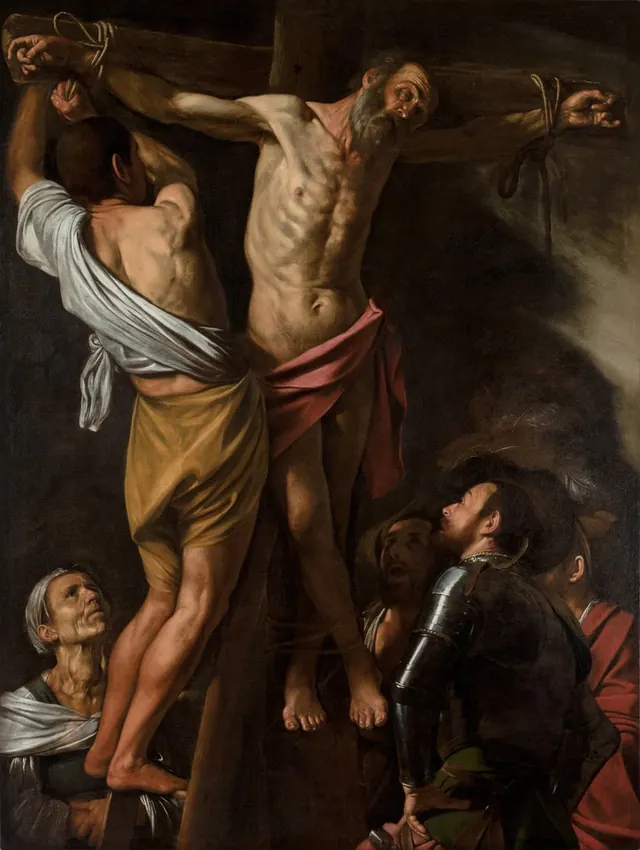
Andrew is still alive on the cross. According to Christian tradition, the apostle continued preaching during his execution after refusing to worship pagan gods. The crowd demanded his release, but Andrew wished to accept martyrdom. Caravaggio painted the scene in Naples in 1606–1607. He chose a moment when rescue seems possible yet fails to happen.
The man on the ladder works at the rope around Andrew’s wrist. Within the legend, he is trying to take the apostle down. A miracle prevents the release as the helpers’ hands lose their power. A gesture resembling the continuation of execution thus belongs to an attempted rescue. Knowing the story changes how the same movement reads.
Light picks out ribs, a hollow abdomen and the taut skin of an elderly body. The painter retains its weight and vulnerability. Outstretched arms follow an ordinary upright cross; the familiar diagonal Saint Andrew’s cross is absent. Caravaggio makes the viewer confront a particular bodily situation before recognizing a conventional religious sign.
An elderly woman raises her face towards the crucified man. Wrinkles, folds of the neck and a slightly open mouth receive the same gravity as the saint’s body. She belongs to the earthly crowd through which the viewer enters the event. Her proximity offers the perspective of someone confronting another person’s suffering.
At the right, light touches another witness’s armour and face. Metal reflects it more sharply than skin. Further heads emerge nearby from the darkness. The space feels crowded although almost no setting is visible. A shared direction of attention unites the group, each person held differently by the event above.
Andrew’s face is illuminated against dense shadow. The lighting connects miracle with physically perceptible light. Modern examination identified incisions and a light-coloured preliminary brush sketch. Removing clouded old varnish clarified spatial depth and figures in shadow. The scene’s apparent immediacy rests on carefully constructed painting.
Two understandings of the good meet at the story’s centre. Witnesses demand that a life be preserved; Andrew seeks to complete it as testimony to faith. Caravaggio gives both a place through the exhausted body and the people looking up at it. Even with the legend in mind, the viewer confronts a difficult boundary between compassion for a person and veneration of his sacrifice.
- Medium
- oil on canvas
- Collection
- Cleveland Museum of Art
- Dimensions
- Unframed, 202.5 × 152.7 cm
- Accession number
- 1976.2
Sources
Image provided under CC0. Image licence