Samson Captured by the Philistines
Guercino · 1619
Explore the painting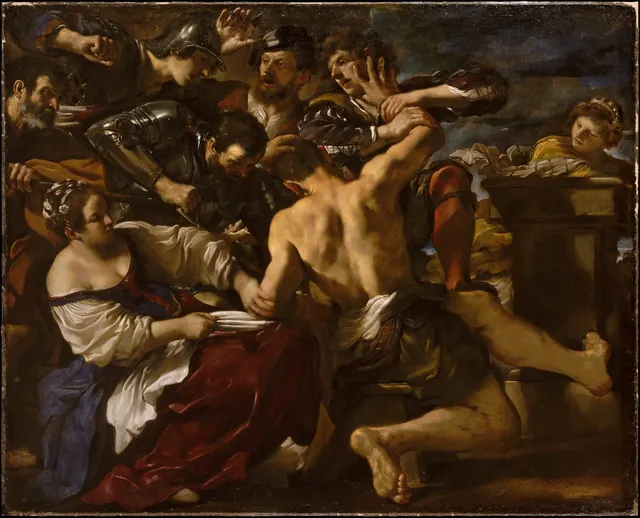
Samson still resists, but several men already restrain his body. Guercino painted this moment in 1619 for Cardinal Giacomo Serra, the papal legate in Ferrara. Nearly two meters high, the canvas was one of several commissions from him. Serra collected contemporary art. A religious story provided both a moral catastrophe and an opportunity for a young painter to organize a large group of bodies into a single urgent action.
Samson’s broad back occupies the center. Light defines its muscles, while torso, legs, and head turn in different directions. In the biblical account, his strength is bound to dedication to God and uncut hair. Delilah discovers the secret and arranges the cutting, after which the Philistines can seize him. Guercino retains his powerful physique. The catastrophe is that his familiar appearance no longer guarantees his former invulnerability.
Delilah occupies the left foreground, close to Samson. The bed and disordered cloth recall that the attack began where he had allowed himself to sleep. A private space became the site of a prepared ambush. The story connects trust, desire, and betrayal. Delilah’s proximity to the attackers preserves that connection even after armed men have taken over the principal action.
The captors’ hands converge around the hero’s raised arm. Some pull while others press and bind. Several differently directed forces act on one body. Figures overlap above and to the left, making the attackers difficult to count at a glance. This crowding gives the imbalance of force a physical form. Samson is enclosed by a group with a shared purpose and divided tasks.
Behind Delilah, a man prepares a weapon. The museum’s study relates the gesture to the blinding that follows Samson’s capture. Guercino places the threat alongside the central action, bringing successive episodes into contact within one image. Light sharply picks out hand and face among shadows. The viewer sees both resistance in the present and preparations for further violence.
A second woman moves away to the right beside the bed. Her movement continues the group’s diverging directions. A preparatory drawing in the Teylers Museum shows Guercino revising the composition. Samson appeared in profile, there were fewer attackers, and Delilah held scissors and hair. In the finished painting, the account of the cutting gave way to a much more crowded and spatially complex struggle.
Serra commissioned other biblical scenes from Guercino. His collecting joined religious subjects with an interest in new painting. Later, his heirs took this canvas to Naples, and it disappeared from scholarly view for a long period. It was rediscovered in Beirut with the Sursock family and entered the Met in 1984. A major ecclesiastical commission thus continued its history in private homes far from Ferrara before reaching a museum public.
- Medium
- Oil on canvas
- Collection
- The Metropolitan Museum of Art
- Dimensions
- 191.1 × 236.9 cm
- Accession number
- 1984.459.2
Sources
Image provided under CC0. Image licence