"Shah Jahan on a Terrace, Holding a Pendant Set With His Portrait", Folio from the Shah Jahan Album
Chitarman · recto: dated 1627–28; verso: ca. 1530–50
Explore the painting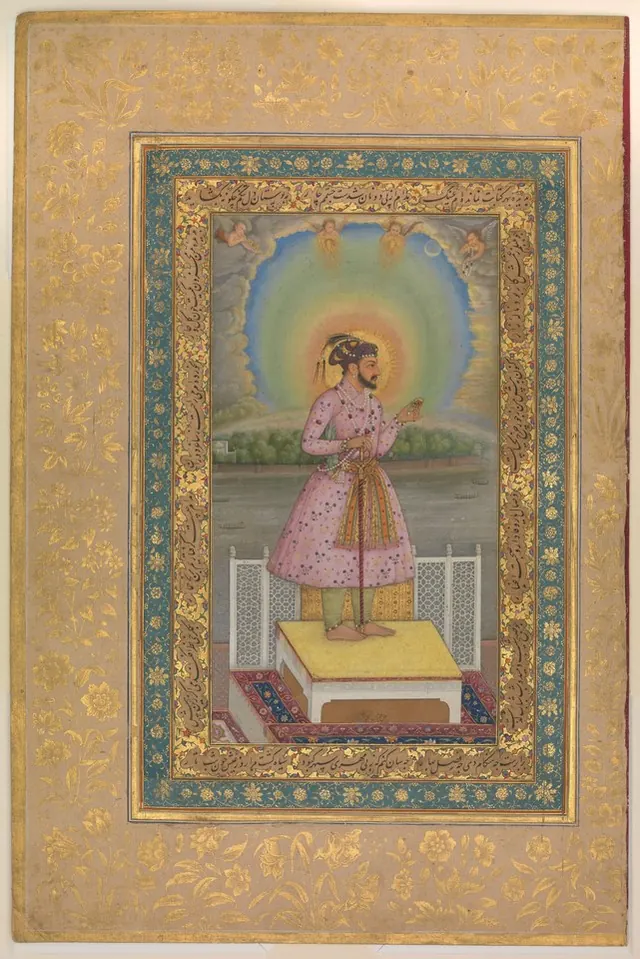
Shah Jahan stands on a terrace holding a small pendant containing his own portrait. Chitarman painted him in 1627–28, at the beginning of the new reign. It is the painter’s earliest dated work. The portrait develops formulas established under Akbar and Jahangir. The new sovereign had to take his place within an existing dynasty, and painting presented his authority through recognizable signs of wealth, heavenly favor, and cultural inheritance.
His raised hand holds an image within the image. The emperor appears as the owner of his own miniature likeness. The jewel connects portraiture with precious material and personal possession. It could be held, passed around, and viewed closely. The full-length figure and tiny portrait differ in scale, but both create a person’s presence through a carefully manufactured object.
A large radiating halo surrounds the head. Angels borrowed from European art hover above. At the Mughal court, such motifs acquired another purpose. Figures familiar from Christian images participate in exalting an emperor. Borrowing involved a change of meaning, as a court painter incorporated a foreign pictorial device into a local language of sovereignty.
Small flowers cover the pale clothing, while belt, weapons, and jewels receive minute attention. These objects represent the work of many court specialists. Weavers, jewelers, armorers, and stoneworkers produced the sovereign’s material appearance. The emperor is motionless, but his magnificence depends on an extensive working community. The painter gathers its achievements around one body.
A pierced railing and decorated platform distinguish the ruler’s position. The space is arranged for his display. No equal inhabitant competes with the central figure for attention. Such a portrait offers an image of concentrated, stable authority. The everyday circumstances of administration, negotiation, and dependence on others remain outside it.
Floral margins surround the painting as a work in their own right. The sheet entered an album begun by Jahangir and enlarged by Shah Jahan. Such collections joined new portraits with earlier calligraphy and drawings. The reverse of this folio contains sixteenth-century work. Possessing predecessors’ art enabled a ruler to appear as a custodian of tradition while commissioning his own image for later generations.
The album passed to Aurangzeb, later changed in contents and binding, and eventually entered the art market. Museums now display its leaves separately. Close viewing was originally the privilege of a small court audience. An image emphasizing one person’s exceptional status can now also be examined through the makers’ labor and the collection’s organization that helped produce that status.
- Medium
- Ink, opaque watercolor, and gold on paper
- Collection
- The Metropolitan Museum of Art
- Dimensions
- 38.9 × 25.7 cm
- Accession number
- 55.121.10.24
Sources
Image provided under CC0. Image licence