Nur Jahan holding a portrait of Emperor Jahangir
Attributed to Bishandas · c. 1627
Explore the painting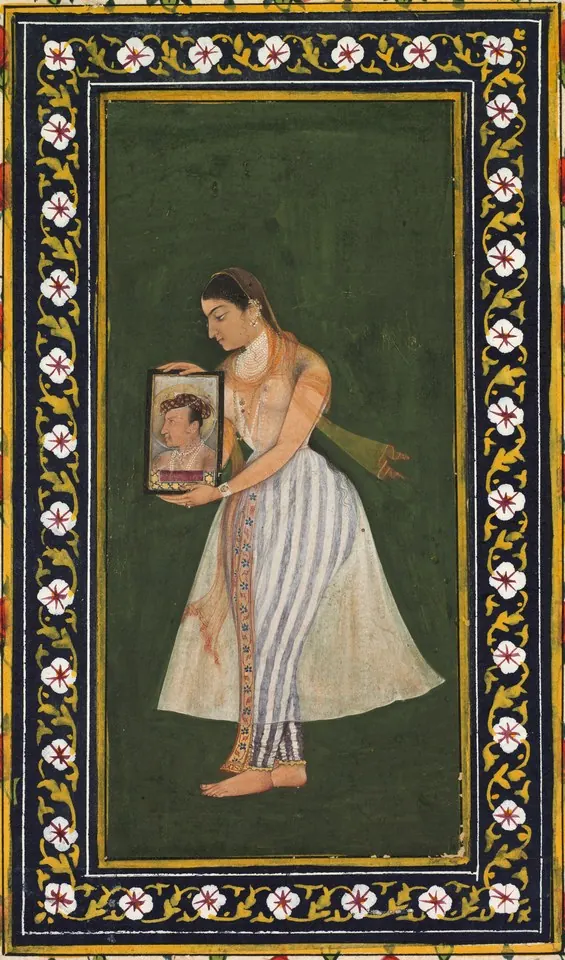
Nur Jahan holds a portrait of her husband, Emperor Jahangir. The miniature is dated to around 1627, when the ruler died and his influential wife faced the question of retaining power. It is attributed to the court painter Bishandas. A marriage becomes a political image here. The woman looks towards a small painting, yet occupies almost the whole pictorial field herself.
Nur Jahan inclines her head towards the portrait. A fine profile and smooth skin present a young beauty, although she was about fifty in 1627. Court imagery preserves an ideal appearance. The experience of a woman who helped govern an empire is conveyed through jewels and the figure’s assured presence, much less through signs of age.
The small portrait shows Jahangir in profile, with a halo and a parapet before him. This setting recalls an imperial appearance at a window before subjects. Even reduced in scale, his image retains signs of sovereign dignity. His grey hair remains visible, making the contrast between the two figures’ apparent ages particularly striking.
One hand supports the frame while the other rests on its upper edge. The portrait becomes an object controlled by Nur Jahan herself. The museum compares this conception with images of Jahangir holding a portrait of his father Akbar and suggests a claim to continuity of power. That reading explains her husband’s presence as a picture within a picture.
Several rows of pearls encircle her neck, while translucent fabric reveals clothing beneath. The painter carefully distinguishes material density, tiny flowers and the shine of ornaments. Wealth appears through details requiring attention. The miniature invites close inspection, revealing its subject’s position through the quality of each possession.
The pale skirt spreads towards the bottom, while long strips of clothing continue the body’s vertical line. Bare feet stand against an even green ground. No room or courtly entourage distracts from the woman and the portrait. Despite abundant ornament, the composition preserves a clear relationship between the two depicted people.
Nur Jahan managed court finances, participated in trade and issued coins bearing her name. After Jahangir’s death, she lost her former position and spent the rest of her life in Lahore. That outcome gives the miniature added force. A powerful woman presents authority through her husband’s image, yet proximity to that image no longer guarantees a political future. Personal remembrance and a claim to continuity can coexist here.
- Medium
- gum tempera and gold on paper
- Collection
- Cleveland Museum of Art
- Dimensions
- Painting only, 13.6 × 6.4 cm
- Accession number
- 2013.325
Sources
Image provided under CC0. Image licence