Jain Ascetic Walking Along a Riverbank
Basawan · c. 1600
Explore the painting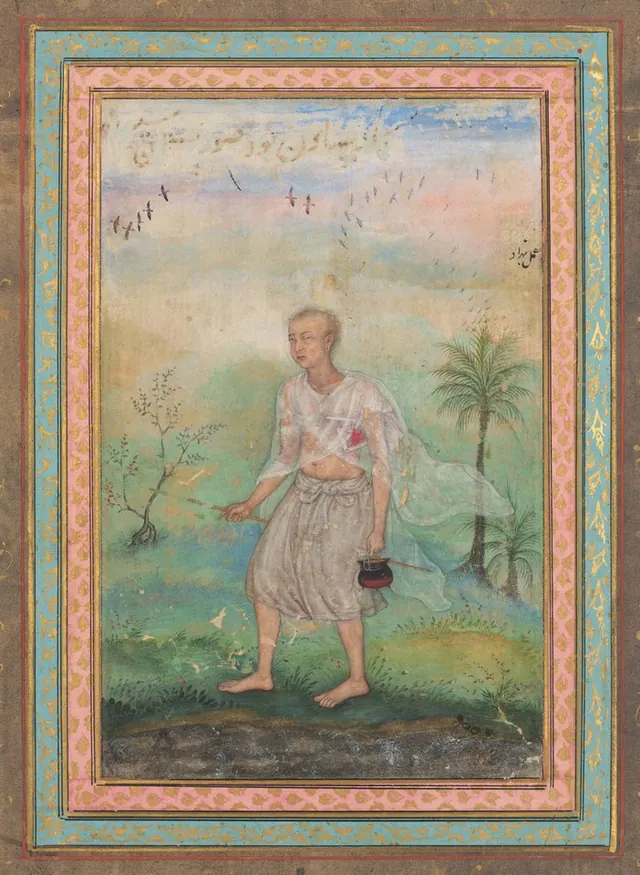
A Jain monk walks along a riverbank carrying a small vessel and a staff. Basavana painted him around 1600 for Emperor Akbar’s collection. Jain teachers participated in religious discussions at the Mughal court, and the ruler took an interest in their teachings. This solitary wanderer’s image therefore arose within a great imperial collection. Renunciation of power and possessions attracted someone who possessed both.
The head turns in the direction of movement. Sparse hair, soft cheeks and a small mouth distinguish the face without reducing it to a generalized emblem of asceticism. A particular human appearance survives, although the monk’s name is unknown. Court painting thus individualizes someone whose dignity did not depend on expensive clothing or courtly rank.
A manuscript in a red covering rests beneath the left arm. Pale clothing allows bodily contours to show through, while the book forms a solid patch of colour. It signifies learning and helps explain Akbar’s interest. Such a visitor could bring an account of his own doctrine to court. He owns few objects, but one preserves knowledge.
A monastic whisk rests beside the manuscript. Jain ascetics use it to move small creatures gently out of the way before sitting, avoiding harm to them. Nonviolence changes the most ordinary actions. A modest implement explains a way of life through a practice readily imaginable beyond religious debate.
A small dark vessel hangs from the hand beside a slender staff. These objects are portable. Together with bare feet, they convey the everyday life of someone travelling on foot without extensive possessions. The painter carefully follows their positions against the body, giving that simple way of living practical credibility.
Slender palms rise at the right as birds cross a pale sky. Pinkish and blue tones dissolve the distance. No surrounding entourage confirms the monk’s status. Nature allows his activity to appear as an independent life. The page’s precious borders return that quiet scene to the world of imperial collecting.
Akbar invited teachers of different religions to his court. The portrait of a Jain monk helps us imagine those encounters and a life unlike that of a courtier. It also raises a question about how freely such conversations could unfold. The emperor could respect a wanderer’s teaching, while the court still commissioned images and chose which to preserve in its collection.
- Medium
- gum tempera, ink, and gold on paper
- Collection
- Cleveland Museum of Art
- Dimensions
- Painting, 14.7 × 9.8 cm
- Accession number
- 1967.244
Sources
Image provided under CC0. Image licence