Shah Jahan
Hashim · c. 1630
Explore the painting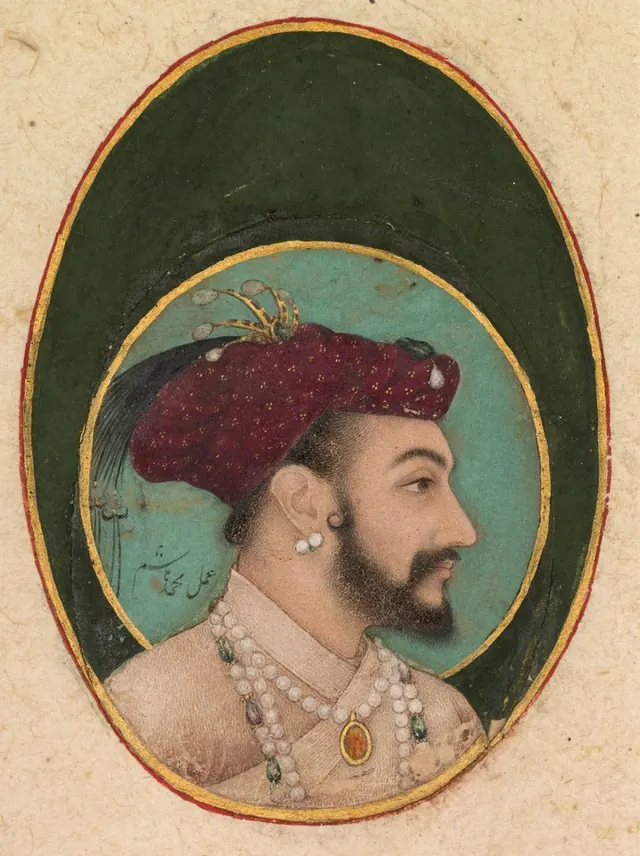
Shah Jahan’s portrait fits in a palm: it is only about five centimetres high. Hashim painted it around 1630, shortly after the ruler ascended the Mughal throne. Immense authority appears through a small head in profile. The format requires proximity and attention, while minute details turn the image into a precious object comparable with the emperor’s own jewels.
A fine continuous line defines the profile. Nose, lips and chin project against an even blue-green ground. Enough light remains on the cheek to preserve the head’s volume. At the same time, the clear silhouette makes the face readily recognizable. Such consistency of appearance was especially important for an imperial image.
A full beard frames the lower face. The Cleveland museum connects it with Shah Jahan’s more orthodox religious stance compared with his father and grandfather. In this reading, even the beard says something about a new reign. Appearance alone cannot establish someone’s convictions, however. What we are considering is an interpretation of the ruler’s presentation at court.
Gold dots cover the red turban. An ornament with large pale stones rises above it, while a dark feather falls at the side. Each element occupies fractions of a centimetre in the original. Wealth appears twice, through represented jewels and actual gold on paper. Courtly luxury continues in the court painter’s workmanship.
Several pearl strands lie over pale clothing. Green stones and a reddish pendant stand out among the white beads. Even in this tiny portrait, Hashim distinguishes the jewels’ colours and shapes. The strands follow the curve of the chest, while pale beads lead upwards towards the beard and face. The costume’s wealth is immediately apparent; its details require a closer look.
Hashim’s signature appears behind the nape. It occupies an open part of the background and is much less conspicuous than the jewels. The imperial likeness preserves the name of its maker. The signature recalls the relationship between painter and patron: personal skill serves another person’s public authority.
A large screen reveals individual hairs, but enlargement changes the encounter. Before the original, viewers must lean towards the portrait and close the distance. An image of an immensely powerful person becomes an almost personal object. Its force depends on combining the sitter’s inaccessible position with the small object’s physical proximity, two conditions rarely easy to reconcile.
- Medium
- Gum tempera, ink, and gold on paper
- Collection
- Cleveland Museum of Art
- Dimensions
- Overall, 5.4 × 3.7 cm
- Accession number
- 1920.1969
Sources
Image provided under CC0. Image licence