Ritual Crown with the Five Transcendent Buddhas
Unidentified painter, possibly Newari · late 14th–early 15th century
Explore the painting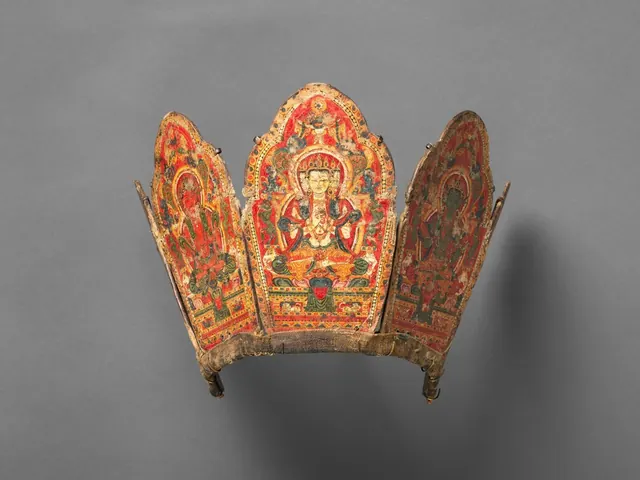
This painting was worn on the head. A monk used the painted crown in Buddhist ritual; objects of this kind could also form part of ceremonial dance costumes. Made in Tibet in the late fourteenth or early fifteenth century, its five sections bear images of Buddhas associated with the directions of sacred space.
White Vairochana occupies the front panel. He sits symmetrically, with his hands joined before his chest. Ornaments and throne details surround him densely, yet the pale face and body remain distinct. His central placement corresponds to his role within the group of five Buddhas.
Red Amitabha appears on the viewer’s left. The adjacent figure repeats the seated pose and shape of the surround. Differences in colour and gesture identify the Buddhas within the crown’s common structure. This is an ordered group of sacred images, rather than several versions of one portrait.
Green Amoghasiddhi is on the right. The side panel turns at an angle, foreshortening its painting. Two other sections are almost hidden in this photograph. To imagine the complete crown, remember that its images surrounded the wearer’s head and faced viewers in different directions.
Each section ends in a tall shaped projection. The upper outline repeats neighbouring sections without forming an even band. Figures, architectural elements, and ornament occupy these small areas. The painting is designed for a surface constrained by the shape of a wearable object.
Details of the throne and decorative bands appear below the central figure. Opaque paint and gold cover a rigid support. This combination allowed the separate sections to retain their shapes during use. Wear recalls the object’s practical handling, although its particular history of ceremonies is unknown.
The lower band joins the sections into a curved structure, making the crown’s scale and manner of wear understandable. In the museum it is still, but during ritual the images changed position with the wearer’s movements. A photograph fixes only one possible view of this painting.
The museum suggests a Newari artist from Nepal’s Kathmandu Valley working in Tibet. This is an attribution, not an established biography. The crown can be studied as refined painting, yet its original meaning depended on a ritual and its wearer. An isolated image on a screen preserves only part of that experience.
- Medium
- Opaque watercolor and gold on board
- Collection
- The Metropolitan Museum of Art
- Dimensions
- Each panel, 19 × 11.2 cm
- Accession number
- 1985.391
Sources
Image provided under CC0. One view of a painted object. The reverse is not shown. Image licence