Double-Sided Painted Banner (Paubha) with God Shiva
Unidentified Nepali painters · 16th-17th century
Explore the painting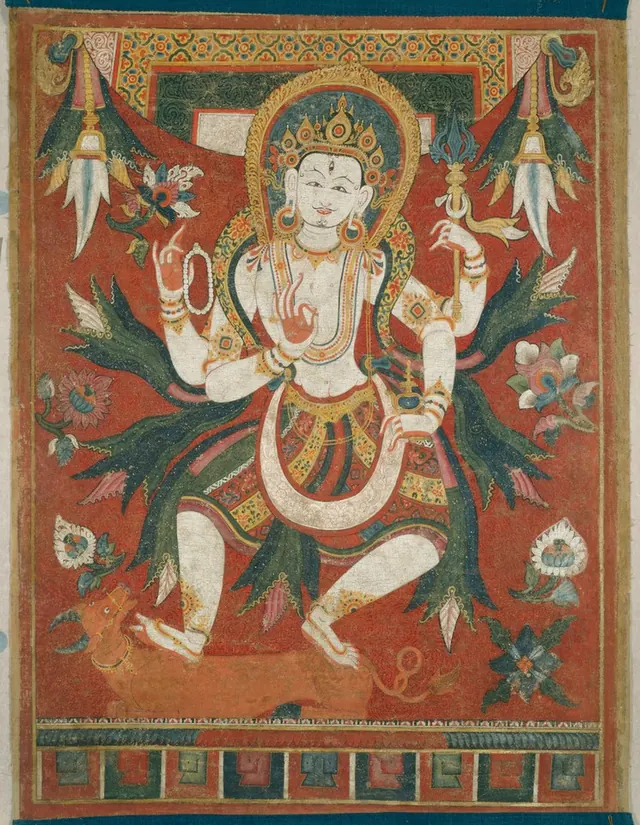
This Nepalese banner was made to be raised above a festival crowd rather than remain still on a museum wall. Both sides are painted. Here Shiva dances on his bull Nandi; the reverse depicts Durga, embodying his divine energy. Large attributes, bright colours and the disposition of the figures relate to this public setting.
Shiva's white face is framed by a golden halo and an ornamented crown. His pale body stands out against red. Multiple arms allow several identifying features to appear at once. The museum suggests that he may be represented as Nataraja, Lord of Dance. A version of this form dancing on a bull is known in Nepal.
A hand before the chest forms a teaching gesture. The fingers are as clearly outlined as the face and ornaments. This conventional sign conveys a divine function without a written label. It should be distinguished from an ordinary human action: the religious image gathers several meanings within one figure.
The upper hand on our left holds a rosary. The other raised hand carries a trident. These recognisable attributes identify Shiva. Placed apart on either side, they leave the face unobstructed. Clarity is particularly useful on a banner seen at a distance and in motion.
The lower hand on our right holds a small stupa, a Buddhist sacred monument. This is an unusual attribute for the Hindu god Shiva. The museum relates it to the overlap of religious traditions in Nepal. The particular object cautions against separating every image according to modern expectations of isolated religious communities.
Shiva stands on a bull that turns its head towards him. Bent legs and turned feet establish the dancing posture. The animal supports the figure and also identifies the deity. It remains fully visible along the lower edge despite being much smaller than Shiva.
Ends of cloth fly upwards and sideways. Tassels and pendants repeat the movement around the edges. These elements animate the picture even before the banner itself moves in procession. The draped upper border suggests festive furnishings beneath which the figure appears.
Large flowers are scattered across the red background. Open intervals leave arms and flying fabrics legible. Gold and pigments on cotton create an object suited both to close inspection of patterns and to recognition in a crowd. The size and placement of details accommodate these different ways of looking.
On the reverse Durga dances on a white snow lion. As the banner turned, different divine images could appear within one procession. The painter's name and exact commission are unknown. Yet the material, two painted faces and arrangement of the figure reveal its role in a festival, where painting moved through space together with people. Showing only one side alters that experience. Shiva becomes an independent picture, while the connection with Durga and the alternation of images disappears. Even a highly detailed enlargement cannot replace knowledge of the object’s reverse and movement.
- Medium
- Pigment and gold on cotton
- Collection
- Art Institute of Chicago
- Dimensions
- 95 × 71 cm
- Accession number
- 1995.268a-b
Sources
Image provided under CC0. Image licence
Adapted and translated from Art Institute of Chicago materials. · Text licence