Ushnishavijaya Within a Chaitya, Commemorating the Laksha Chaitya Vrata (Thousand Chaitya Ritual), with Dated Inscription
Unidentified Newari painter · 1513
Explore the painting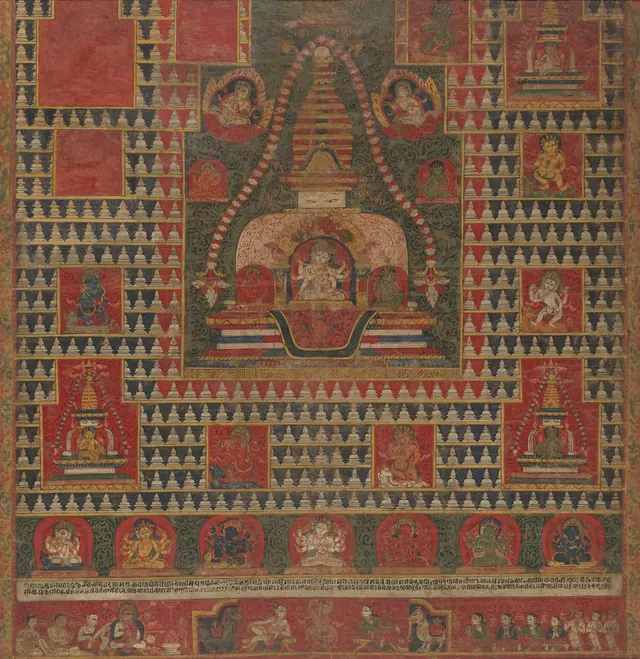
In autumn 1513 a Newar patron dedicated a major rite to the welfare of his wives, children and grandchildren. Participants made small clay stupas to be consecrated. This painted cloth banner, or paubha, took part in the ceremony and preserved its memory. A date, family dedication and information about the ritual master appear below. The sacred image also documents a particular collective event.
A large stupa occupies the centre. In Nepal this sacred structure is called a chaitya. A goddess sits within it, surrounded by smaller stupas. The central architectural form connects the figure with the ritual's principal activity: making numerous miniature sacred structures by hand.
White Ushnishavijaya sits at the centre with eight arms and three faces, each with three eyes. Her appearance follows established iconography, combining attributes and actions that an ordinary human body could not perform together. Red and green companions frame her within the central niche.
Rows of small stupas fill nearly every available space. The ritual is called Lakshachaitya, the rite of one hundred thousand stupas. Repetition makes each small object part of a vast whole. The painted surface gives visible form to participants repeatedly shaping clay shrines.
A form of Tara appears in the lower left corner shrine. Other deities interrupt the repeated rows, requiring recognition of individual figures within a shared order. The space serves devotional contemplation rather than depicting an actual building complex from one viewpoint.
The corresponding shrine on the right sustains symmetry. Directional guardians on animals and other protective beings join the ensemble. Their presence places a family dedication within a wider religious world.
The long Newari inscription records the occasion and the ceremony’s completion. It establishes autumn 1513, although this rite was usually performed in summer. Writing makes a recurring religious image commemorate one event. Behind the rows of identical stupas emerges a particular family praying for wellbeing.
At the lower right people pray and make small stupas; on the left a priest performs a fire offering. These scenes depict the activity in which the paubha participated. Making clay shrines normally occupied a month. After consecration they were deposited within a larger stupa or a sacred river. Collective work and its ritual completion generated the event's significance.
The rite belongs to Newar Buddhism in the Kathmandu Valley. Admiring repetition as pattern can overlook the time and shared responsibility of making. Memory is uneven too: the inscription preserves patronage and family dedication more fully than each participant's individual contribution. The cloth invites discussion of collective ritual labour and the unequal visibility of its contributors.
- Medium
- Opaque watercolor with gold on cotton
- Collection
- Art Institute of Chicago
- Dimensions
- 58.2 × 57.2 cm
- Accession number
- 2014.1040
Sources
- Unidentified Newari painter. Ushnishavijaya Within a Chaitya, Commemorating the Laksha Chaitya Vrata (Thousand Chaitya Ritual), with Dated Inscription · Art Institute of Chicago
- Ushnishavijaya Within a Chaitya, Commemorating the Laksha Chaitya Vrata (Thousand Chaitya Ritual), with Dated Inscription · museum description, history and collection data
Image provided under CC0. The museum reproduction may omit a narrow part of the upper edge. Image licence
Adapted and translated from Art Institute of Chicago materials. · Text licence