The Medicine Buddha Bhaishajyaguru With His Mandala Retinue
Unidentified Tibetan painters · 14th century
Explore the painting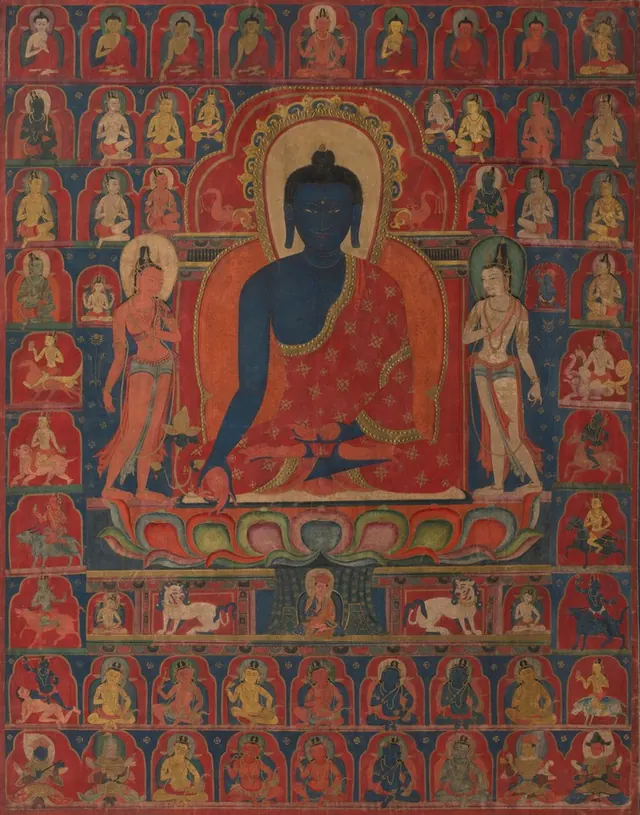
This fourteenth-century Tibetan thangka was dedicated to Bhaishajyaguru, the Medicine Buddha. A prayer on the reverse seeks a favourable rebirth for its unnamed donor. The words reveal the work's purpose: assisting devotion to a Buddha revered as a healer. In Buddhist thought, healing also encompassed release from suffering generated by attachment, aversion and ignorance.
His blue body relates to the title Healing Master with Lapis Lazuli Radiance. This established feature distinguishes him from other buddhas. The museum connects the colour with prayers comparing wisdom and compassion to the vastness of the sky.
Golden motifs ornament the red monastic robe. Cloth covers one shoulder and leaves the other exposed, clarifying the body's position. One hand rests in the lap in meditation. Gold and saturated colour distinguish the central figure from the surrounding rows while preserving the patterned image's shared surface.
The lowered right hand holds a myrobalan plant, a medicinal attribute in this iconography. The small object identifies the Buddha and connects the image with hopes of healing. It helps explain why a donor would appeal to this particular figure. A specific detail makes the thangka’s religious function legible.
A large lotus separates Bhaishajyaguru from the lower groups. Alternating coloured petals form a broad base. Padmasambhava appears beneath it between lions. His presence and invocation on the reverse suggest a connection with the Nyingma tradition, which particularly venerates him.
The red Suryaprabha, associated with sunlight, stands on the left. His slender upright figure reaches almost to the central Buddha's shoulders, making a group of three within the much larger assembly. Crown, jewels and gestures distinguish him from buddhas wearing monastic robes.
White Chandraprabha on the right is associated with moonlight. The paired companions make the centre legible before we explore the smaller peripheral figures. Colour both identifies religious beings and guides us across a surface with little empty space.
The lower registers include twelve yaksha generals, while directional guardians occupy the sides. Their attributes and animal mounts differ. Together the retinue belongs to Bhaishajyaguru's mandala. Gradual attention to each figure relates to learning a complex religious order as well as enjoying intricate details.
The thangka combines Nepalese, Indian, Central Asian and Tibetan traditions. Artists, teachings and models travelled between these regions. Within that broad geography stands a private prayer for the donor’s future. Costly materials and an intricate composition supported an appeal to the healing Buddha, connecting personal hope with a shared religious order.
- Medium
- Pigment and gold on cotton
- Collection
- Art Institute of Chicago
- Dimensions
- 104 × 82.7 cm
- Accession number
- 1996.29
Sources
Image provided under CC0. Image licence
Adapted and translated from Art Institute of Chicago materials. · Text licence