The Ambassadors
Hans Holbein the Younger · 1533
Explore the painting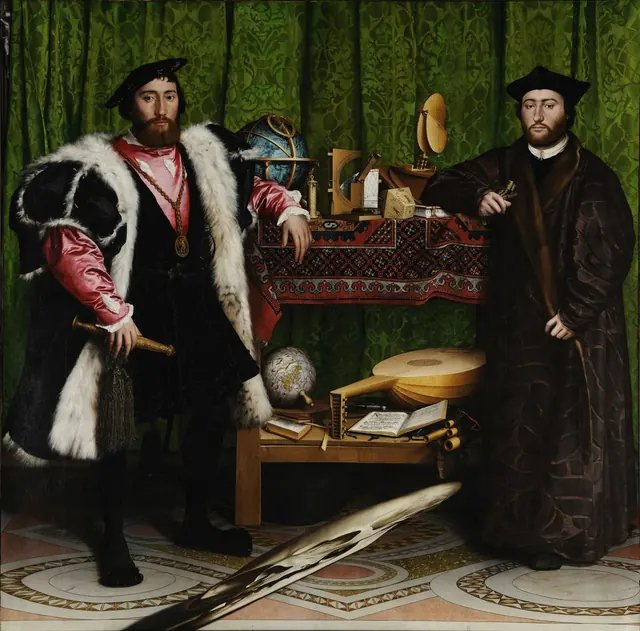
In 1533, French ambassador Jean de Dinteville was in London observing Henry VIII’s marriage to Anne Boleyn and the king’s conflict with Rome. His friend, Bishop Georges de Selve, visited him. Holbein painted them almost at life size for Dinteville’s château at Polisy. The objects between them connect a personal meeting with the learning, wealth and religious politics of their time.
Dinteville stands broadly in a fur-lined cloak over pink silk. Highlights and shadows sharply distinguish the sleeve, while individual hairs line the fur. Viewers could read the owner’s status through his clothing and Holbein’s skill through the rendering of materials. The artist used actual gold leaf on the dagger’s tassels. Wealth is represented both by depicted objects and by the painting’s own substance.
De Selve rests on a book. His clothing is darker but equally attentive to fabric texture and fur lining. Both men belonged to an educated diplomatic world. Their composed poses do not mean that life beyond the portrait was settled. Dinteville’s letters complained about his difficult stay in England; his friend’s visit offered relief. The painting gives that meeting a stable, ceremonial appearance.
An elongated pale image lies below. Viewed at an acute angle from the right, it resolves into a skull. This device is called anamorphosis. Holbein makes viewers change their position to recognize an object. The skull recalls death amid signs of success while also demonstrating expertise in perspective. The painter’s knowledge participates in the display of accomplishment embodied by the instruments above.
The lute has a broken string, and a Lutheran hymn book lies open beside it. The National Gallery connects the damaged instrument with discord and the hymns with a possible hope for Christian unity. This is a historically grounded interpretation, but not a uniquely determined political message. The same objects represent educated pursuits and let Holbein describe wood, paper and strings minutely.
The upper shelf holds a celestial globe and instruments for measuring time and the positions of heavenly bodies. Their complexity relates to mathematics, astronomy and expensive craftsmanship. Such objects required money and access to specialized knowledge. The portrait places its owners within that world. Their presence alone, however, does not prove that either man could operate every instrument.
A small crucifix is partly hidden behind the green curtain. It is easily overlooked amid the many objects. Together with the skull, it permits a Christian reading about death and salvation. Yet viewers first encounter wealth, faces and instruments, discovering the religious sign later. The order of attention becomes meaningful: something important can occupy very little space.
The portrait can commemorate friendship, present social standing or reflect on the uncertainty of worldly achievement. These readings can coexist. For a guest at Polisy, the image also spoke about the house’s owner. A modern museum visitor lacks that encounter. We gain freedom to compare its signs while needing to remember whose space originally brought them together.
- Medium
- Oil on oak
- Collection
- National Gallery, London
- Dimensions
- 207 × 209.5 cm
- Accession number
- NG1314
Sources
Reproduction of a public-domain artwork. Image licence