Portrait of a Carthusian
Petrus Christus · 1446
Explore the painting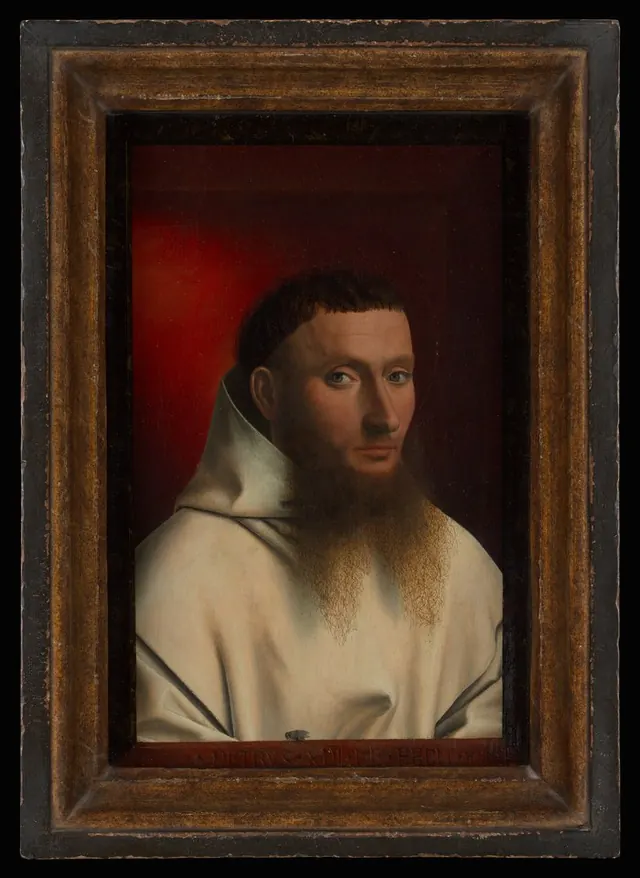
For a time, this man was considered a saint because of a halo the painter never made. The later addition was removed before a 1994 exhibition. Beneath it remained a portrait signed by Petrus Christus in 1446. Conservation returned attention to an unidentified member of a Carthusian community and to the painter’s convincing presentation of his presence.
The face turns slightly toward us. Wrinkles, individual hairs, and irregularities of skin remain visible. Christus constructs a particular person’s appearance without subsuming it into a standard saintly type. The name is lost, but the portrait’s individuality survives in these uneven particulars.
The beard and absence of a tonsure helped establish the sitter’s position. Scholars identify him as a Carthusian lay brother whose position differed from that of choir monks. Religious communities contained different responsibilities and rules of appearance. The portrait preserves distinctions that the later halo nearly obscured.
The white hood opens widely around the neck. Soft light models its folds without ornament or jewels. Clothing establishes communal belonging while the face retains a personal appearance. Modest dress does not prevent the portrait from being an exacting object of considerable craftsmanship.
The red wall turns behind the head, marking a room’s corner. Earlier portraits often used a plain dark ground. Christus surrounds the sitter with space in which we can imagine his body. The later halo interrupted that convincing interior, turning part of the wall into a sign of sanctity.
A fly rests on the lower edge. Painted on an illusionistic stone frame, it resembles an accidental visitor to the portrait itself. The artist placed his signature and date nearby. The tiny insect tests the boundary between the depicted person, the painted frame, and the viewer’s space.
A halo added later transformed the portrait of a lay brother into an image of a saint. After examining the surface, conservators removed the addition and restored the portrait’s earlier appearance. Its history shows how one image’s function changed. The face survived, but a detail around the head temporarily changed whom the viewer believed this person to be.
- Medium
- Oil on oak
- Collection
- The Metropolitan Museum of Art
- Dimensions
- 29.2 × 21.6 cm
- Accession number
- 49.7.19
Sources
Image provided under CC0. Image licence