Niagara
Frederic Edwin Church · 1857
Explore the painting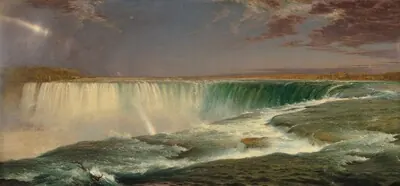
Church combines the near and far sides of the falls into a view unavailable from one fixed human position. The viewer seems to hover over the torrent. Niagara was a symbol of American natural power and also a border near routes by which enslaved people sought freedom in Canada.
A broad curtain of white water spans the view. Its extent presents the falls as a large continuous force.
Green waves fold over the rocky edge. The change in the water's position is especially clear at the drop.
Mist rises along the falls. It conceals lower areas and reveals the torrent's effect on the surrounding air.
Dark clouds open toward light. The sky continues the broad changes in brightness visible in the water.
Rushing water fills the immediate foreground. The viewer is left with almost no visible foothold on land.
Church built large paintings from observations combined in the studio. Here several viewpoints become one persuasive view. Niagara's national significance included both natural grandeur and the particular history of a border region.
- Medium
- oil on canvas
- Collection
- National Gallery of Art, Washington
- Dimensions
- Overall, 101.6 × 229.9 cm
- Accession number
- 2014.79.10
Sources
Reproduction of a public-domain artwork. Image licence