Twilight in the Wilderness
Frederic Edwin Church · 1860
Explore the painting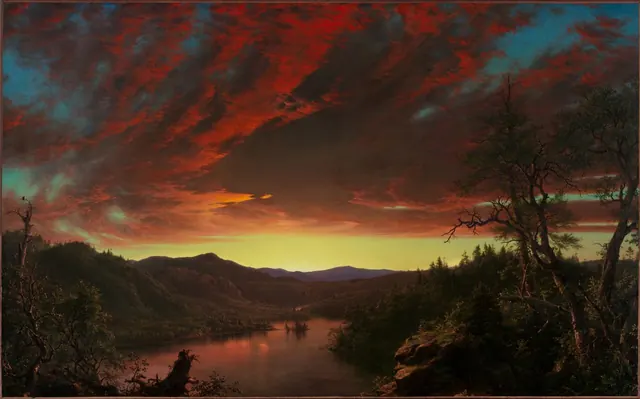
A blazing sunset hangs above forests and a lake in Maine. Frederic Edwin Church painted the work in his New York studio in 1860, using sketches from a journey nearly two years earlier. A natural impression passed through memory and sustained work. He prepared a spectacle capable of holding attention when a single canvas was exhibited alone.
Red clouds extend in long slanting bands. Dark interiors and glowing edges create immense depth. Sky occupies most of the painting, pressing the earthly world towards a low horizon. The viewer encounters a scale far beyond familiar human dimensions.
Near the horizon, red gives way to pale yellow and then cool blue mountains. The colour transition greatly extends the distance. The eye travels from a heavy nearby cloud towards quiet remoteness. Church holds the sky’s unsettling force and the ground’s stability within a single view.
The lake reflects warm light. Small islands and projecting banks divide its surface and help measure space. Reflection returns the sky to earth in a quieter form. Light carries the eye between dark forests towards the horizon.
Old trees at the right stand nearly black against the sunset. Individual branches and needles remain visible in deep shadow. Nearby vegetation supplies an imagined stopping place. We look into the distance from a sheltered forest edge, as though the painting offered a secure position beside an immense spectacle.
A broken trunk rises before the water. Its irregular edge and surrounding young branches recall changes within the forest. Church preserves small details below while nearly dazzling light unfolds above. The grand effect rests on work discovered only at close range.
The painting was shown alone in a prestigious gallery, where publicity and enthusiastic reviews brought hundreds of visitors. It appeared on the eve of the American Civil War. The museum allows a reading of the fiery sky as anticipating the coming conflagration, although the sunset remains a natural event. Both belong to its history: admiration for American landscape and anxiety within a country about to divide.
- Medium
- oil on canvas
- Collection
- Cleveland Museum of Art
- Dimensions
- Unframed, 101.6 × 162.6 cm
- Accession number
- 1965.233
Sources
Image provided under CC0. Image licence