Distant View of Niagara Falls
Thomas Cole · 1830
Explore the painting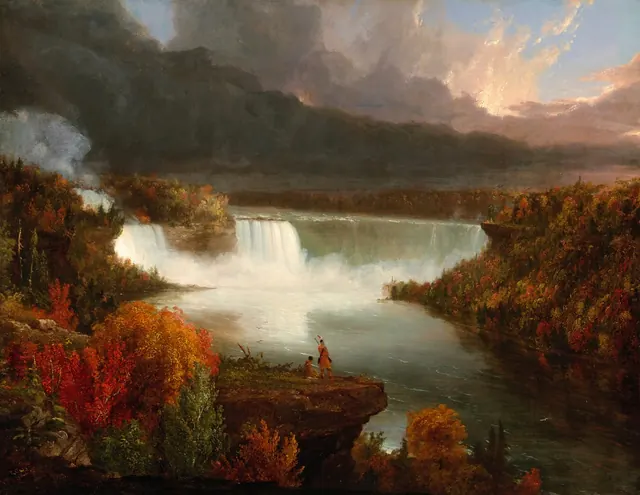
Thomas Cole visited Niagara Falls in May 1829. Painted the following year, this landscape shows autumn and an almost uninhabited setting. That difference already identifies it as a studio composition. Cole selected season, lighting and details to construct a particular image of American nature. A crucial part of that selection concerns what he left out.
The falls lie beyond a dark foreground. Their pale band occupies a relatively small area, but the river, cliffs and wooded banks all lead towards it. Distance allows us to take in an immense territory. This arrangement belongs to Romantic landscape painting, in which nature's scale is experienced through the viewer's position before it.
Mist rises where the water falls, concealing its lower reaches and softening the cliffs. Nearby trees and rocks remain distinct; farther away, objects merge into broad masses of colour. These differences establish depth and suggest moisture in the air.
Two small Native American figures occupy the ledge, one standing and the other seated. They help indicate the scale of the surroundings, but their presence also requires historical context. The region encompassed Attiwonderonk, Haudenosaunee and Wenrohronon lands, among others. Colonial conquest transformed these peoples' lives and dispossessed them of sovereignty. The painting offers little access to those circumstances.
Red and orange foliage establishes autumn. Since Cole visited in spring, these leaves do not record conditions on the day of his trip. He deliberately transformed what he had seen. Warm trees in the foreground contrast with the cool mist and distant water, extending the apparent depth of the view.
Golden light breaks through the clouds on the right, opening the distant landscape while heavier clouds gather on the left. The changing illumination suggests unsettled weather. Light and shadow seem capable of rapidly altering the appearance of this familiar landmark.
The river reaches the lower edge, making the foreground our vantage point over the valley. Hotels, factories and viewing platforms already occupied the area in the early nineteenth century. Cole omitted them. Their removal presents Niagara as nearly untouched, although economic activity had long transformed its surroundings.
The heavy cloud heightens the impression of nature's power. Cole was concerned about the effects of industrial development. The museum's current interpretation also draws attention to another consequence of his selection. The almost empty view reinforced the false idea of vanishing Native peoples, concealing the effects of conquest behind the grandeur of the landscape.
The painting preserves two connected attitudes of its period. It values nature in the face of industrial expansion, while also showing how an image of nature could exclude the history of its inhabitants. The larger view becomes more revealing when we remember the hotels, industries and communities outside Cole's chosen picture.
- Medium
- Oil on wood panel
- Collection
- Art Institute of Chicago
- Dimensions
- 47.9 × 60.6 cm
- Accession number
- 1946.396
Sources
Image provided under CC0. Image licence
Adapted and translated from Art Institute of Chicago materials. · Text licence