Heart of the Andes
Frederic Edwin Church · 1859
Explore the painting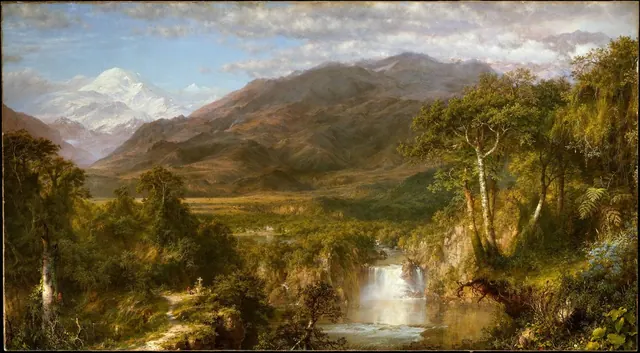
In 1859 audiences came to see this single painting as an exhibition in its own right. Church encouraged them to examine it through opera glasses. The enormous canvas offered a journey from dense vegetation at their feet to snow-covered peaks. Alternating between the whole view and individual details belonged to the original display.
Church visited South America in 1853 and 1857. He was drawn to Alexander von Humboldt’s writings about relationships within nature. Using drawings and painted studies made in Ecuador, he constructed a landscape that brings different elevations and climatic zones together. This continuous view emerged from many separate observations.
The snowy peak at the left is painted in cool whites and blues. Its outlines are softer than those of the nearby branches. Several mountain ridges lie between it and the viewer, each differently lit. They let the eye travel a great distance gradually, through a succession of intermediate planes.
The waterfall draws the eye with a patch of light. Above it, water disappears among rocks and trees; below, it reflects the green banks. Its course connects the distant valley with the near edge of the canvas. Translucent spray and dark reflections require different brushwork even though they depict the same substance.
At the right a pale trunk branches against the mountains. Its crown, hanging vegetation, and exposed roots beside the water remain distinguishable. These small forms survive within the panorama because Church varies the lighting within the vegetation itself. One edge of the tree catches bright light while the other merges into dark green.
A cross stands beside the path at the left, with tiny people nearby. Their size helps us judge the height of the trees. The valley is inhabited: buildings can also be seen below the mountains. Close looking modifies the first impression of boundless nature by revealing human paths and places of devotion within it.
A light band of valley crosses the middle of the painting. Compared with the dense foreground, large areas of land are easier to distinguish here. This transition alternates two scales of attention. Nearby, the eye pauses over leaves; farther away it takes in an entire slope before reaching the peaks.
At the left edge the dark vegetation almost closes together. Light picks out individual leaves and parts of trunks without revealing everything equally. These shadows make the illuminated valley seem more spacious. Looking only at details can obscure this arrangement of light; the complete view restores its importance.
The paid exhibition offered urban audiences a traveller’s view of a distant country. People in the valley are tiny, while nature occupies almost the whole canvas. This choice invites discussion: how much does the landscape reveal of Ecuadorian life, and how much of the artist’s and his American viewers’ expectations? It supplies far more detail about vegetation and terrain than about local inhabitants.
At its first display, concealed gas lamps lit the canvas and a large frame resembled a window. Admission cost twenty-five cents. A painted investigation of nature became an urban spectacle available without an ocean crossing. The original frame is lost, but the painting still invites alternating between a distant view and prolonged scrutiny of small details.
- Medium
- Oil on canvas
- Collection
- The Metropolitan Museum of Art
- Dimensions
- 168 × 302.9 cm
- Accession number
- 09.95
Sources
Image provided under CC0. Image licence