Avalokiteshvara Teaching a Devotee
Mahavihara Master · early 12th century
Explore the painting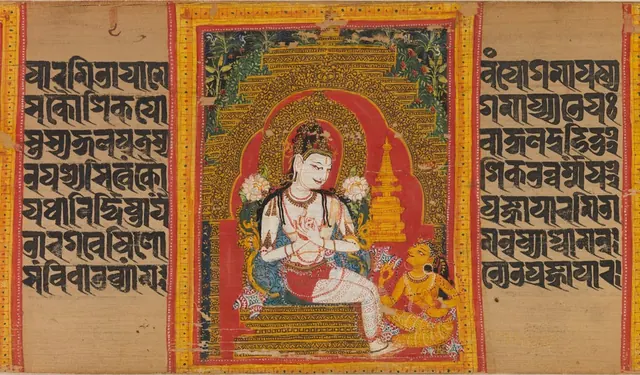
This small image belonged among the lines of a substantial Buddhist book. On an early twelfth-century palm leaf, Avalokiteshvara teaches a woman. The manuscript of the Perfection of Wisdom in Eight Thousand Verses was produced in Bengal. Its surviving parts are now in New York and Lhasa; the painter’s name is lost, and scholars call him the Mahavihara Master.
The white body, crown, and jewels identify Avalokiteshvara, the bodhisattva of compassion. Buddhist assistance to living beings takes the form of personal instruction. No crowd of intermediaries stands between teacher and listener. Within the manuscript’s confined field, the painter makes room for their encounter.
Both hands form vitarka mudra, the gesture of teaching. Its repetition emphasizes the action around which the scene is organized. Jewels and throne establish dignity, while the hands show what the figure is doing. The book’s teaching acquires a visible instructor.
The female devotee sits at the lower right, turned toward the bodhisattva. Another surviving leaf records the manuscript’s donation by Queen Vihunadevi. The painted woman has not been identified. Women occupy two significant positions in the book’s history, as a recipient of instruction and as the person who funded a sacred gift.
A stupa stands nearby, a structure associated with relics and the Buddha’s presence. It shares the teaching space with lotus flowers. Written doctrine, sacred image, and remembrance of the Buddha meet on a single leaf. Such a book could be read and venerated.
An elaborate temple rises above the figure. Its forms connect the image to Pala-period architecture. The leaf preserves traces of an environment of major Buddhist monasteries and costly manuscript production. A royal donation supported scribes and painters who turned a text into an object fit for offering.
Beauty had a practical religious purpose in this book of wisdom. A carefully made image helped honor and preserve the teaching. The manuscript also records the resources its transmission required. The ideal of compassion reached its audiences through particular people, workshops, and donations.
- Medium
- Opaque watercolor on palm leaf
- Collection
- The Metropolitan Museum of Art
- Dimensions
- Image, 6.4 × 4.9 cm
- Accession number
- 2001.445f
Sources
Image provided under CC0. The miniature is complete; the rest of the manuscript folio is not included. Image licence