Devananda's Fourteen Auspicious Dreams Foretelling the Birth of Mahavira: Folio from a Kalpasutra Manuscript
Master of the Jaunpur Kalpasutra · ca. 1465
Explore the painting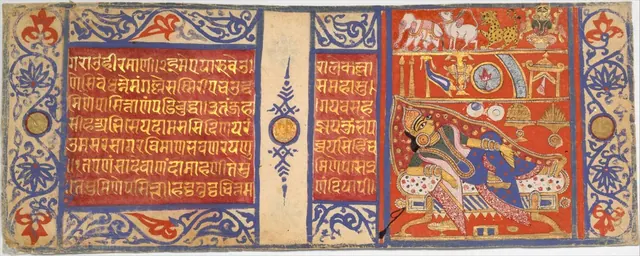
Fourteen dreams foretell the coming of a great teacher. On this Kalpasutra folio, Devananda experiences them. This Jain sacred book recounts the lives of the tirthankaras, teachers of the path to liberation. The episode belongs to Mahavira’s story. Around 1465, the painter gathered the dream signs above the woman’s bed on a single page.
Devananda rests on an ornamented bed. Her large eyes remain open even in a dream scene, following pictorial convention. The Kalpasutra gives her an unusual role: Mahavira’s embryo will later be transferred from her to Queen Trishala. The dreams foretell the teacher’s arrival before that change.
An elephant, bull, and lion can be distinguished in the upper row. They appear as separate signs, without a shared landscape or scale. Their juxtaposition belongs to the dream. Recognizability matters more than creating a continuous setting, allowing the images to accompany the telling of the sacred story.
The remaining emblems also form rows. The area above the bed operates differently from a room in an everyday scene. Separate time labels do not divide the dreams. Viewers compare the signs and relate them to the coming teacher. The narrative is built from a group of omens rather than successive actions.
Golden lettering stands against a red ground. Text and image share a similar decorative richness. The elongated format preserves the structure of palm-leaf books, although this folio is paper. A change of material did not immediately displace the familiar form of a sacred manuscript.
Deep blue and gold combine with red. The museum relates the use of lapis-derived ultramarine and gold to awareness of Iranian painting under the Delhi Sultanate. The Jain subject retains local pictorial conventions. Religious difference did not preclude the exchange of artistic practices.
The luxurious page accompanies teachings of release from attachment, while the sacred book itself becomes a precious object. Gold and deep blue distinguish it from everyday things, and its familiar format links successive generations of readers. New materials carry the great teacher’s story within an enduring form.
- Medium
- Opaque watercolor on paper
- Collection
- The Metropolitan Museum of Art
- Dimensions
- Overall, 11.8 × 29.2 cm
- Accession number
- 1992.359
Sources
Image provided under CC0. Image licence