Shiva and Parvati Playing Chaupar: Folio from a Rasamanjari Series
Devidasa of Nurpur · dated 1694–95
Explore the painting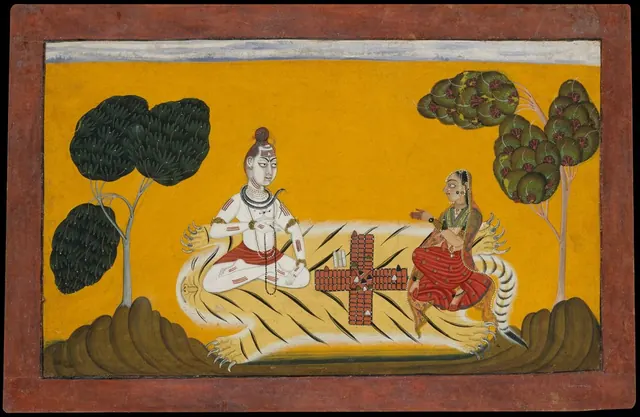
A game of chaupar has ended in a dispute. Shiva has cheated Parvati out of her necklace, and she asks for it back. Devidasa of Nurpur painted the scene in 1694–95 for a series illustrating Bhanudatta’s Rasamanjari, a Sanskrit text about relationships in love. The divine couple enters a situation recognizable to a human audience.
A cross-shaped board and pieces lie between the couple, with three elongated dice beside them. The game is shown from above, making its arrangement legible, while the players appear from the side. The painter combines viewpoints to clarify the action rather than imposing a single perspective.
Parvati extends an open hand toward her husband, demanding the ornament’s return. Her face and shoulders turn toward Shiva. Red clothing and outstretched hands make the appeal distinct against the flat yellow field. The game has stopped, while her gesture continues the dispute over its result.
Shiva sits on a tiger skin, his pale body marked with red stripes. His hair rises in a tall arrangement, and a snake circles his neck. These attributes retain his divine identity within a domestic quarrel. His face turns more toward the viewer than Parvati’s, distinguishing their responses through pose.
The tiger skin tilts steeply toward us, exposing paws, claws, and black stripes. It holds players and board within one area. A flat yellow field surrounds them without a detailed landscape. Dense paint, strong color relationships, and shallow space characterize Basohli painting.
The trees differ in foliage, but both incline toward the center. Leaves form distinct ornamental clusters. Devidasa belonged to a family whose successive generations illustrated the Rasamanjari. Returning to the same text allowed painters to inherit and modify compositions instead of reinventing an entire visual system.
Shiva remains a recognizable deity with his attributes even while cheating at a game. Parvati responds with a demand familiar from a human dispute. Sacred figures admit comic awkwardness and recognizable reactions. Within the Rasamanjari tradition, such proximity allowed divine stories to address the subtleties of love.
- Medium
- Opaque watercolor, ink, silver, and gold on paper
- Collection
- The Metropolitan Museum of Art
- Dimensions
- Image, 16.5 × 27.6 cm
- Accession number
- 57.185.2
Sources
Image provided under CC0. Image licence