Lions at the Stone Bridge of Mount Tiantai
Soga Shōhaku · 1779
Explore the painting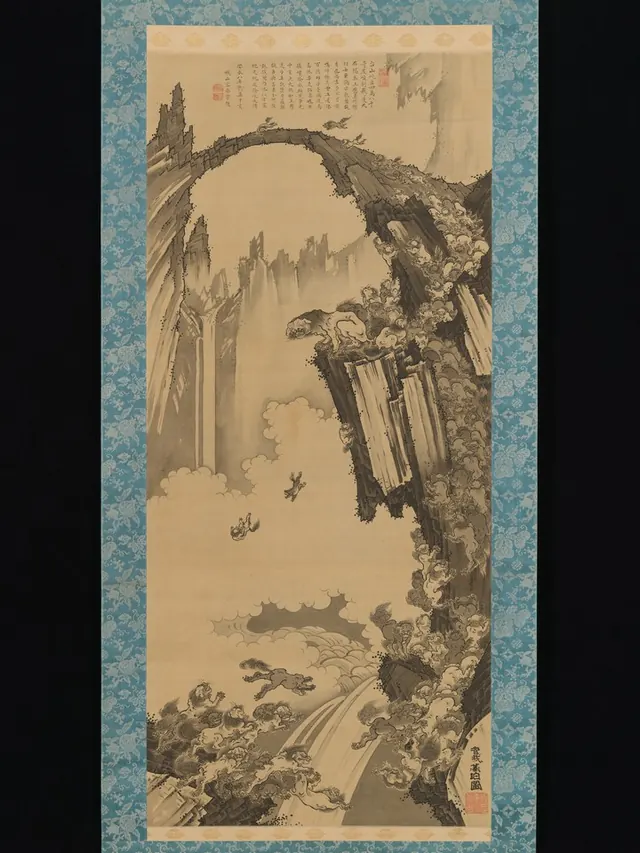
Fantastic lions climb and fall among cliffs. Soga Shōhaku painted this scroll in 1779, two years before his death. Its subject concerns China’s Mount Tiantai and its natural stone bridge. According to legend, a lioness throws down her cubs and accepts those able to climb back. In this moral tale, lions undergo a brutal test of endurance. The painter expands it into movement between summit and abyss.
High above, the stone bridge joins two steep slopes in a narrow arc over emptiness. Chinese and Japanese traditions treated mountains as meeting places between human and supernatural worlds. Tiantai is associated with its namesake Buddhist school and with Daoist practices. The perilous route therefore has a religious setting, and height carries more significance than an ordinary difficult climb.
Large lions gather on the right ledge. Curled manes, broad muzzles, and rounded eyes belong to a tradition of fantastic lion imagery. Shōhaku repeats related forms in changing orientations. Their density contrasts with the open middle. The animals nearly fill the cliff edge, so an outward movement leads directly into the abyss.
Two small cubs fall through open space. Their bodies turn differently, with no support for their paws. The difference between the sheer landscape and a small living creature becomes especially sharp. The legend has often been compared with a teacher’s severe testing of pupils. Yet this selected moment also exposes the cost from the position of the one compelled to undergo it.
Below, animals gather beside water and rocks while others stretch into leaps. Their numbers turn an episode into a repeated system of trials. The eye can follow one body or the entire circuit along the right edge. Broad white flows and hard rock faces alternate with curling manes. Different brush movements distinguish water, stone, and animals within monochrome painting.
Gazan Nansō’s inscription appears above the bridge. The scroll joins a painter’s work with a text by another author. Shōhaku is known for exaggerated forms and unusual subjects, but the fantasy rests on highly organized drawing. The nearly empty middle establishes height while animals accumulate along the edges. Apparent frenzy develops within carefully distributed space.
The parable invites admiration for those strong enough to return. The falling cubs leave open a question about the trial itself. A survivor’s success and the powerful figure’s right to endanger the weak need not receive the same judgment. Shōhaku depicts no separate debate between students and teachers, yet his scene makes vulnerability visible enough to keep the familiar moral open to discussion.
- Medium
- Hanging scroll; ink on silk
- Collection
- The Metropolitan Museum of Art
- Dimensions
- Image, 114 × 50.8 cm
- Accession number
- 2015.300.216
Sources
Image provided under CC0. Image licence