Quail and Millet
Kiyohara Yukinobu · late 17th century
Explore the painting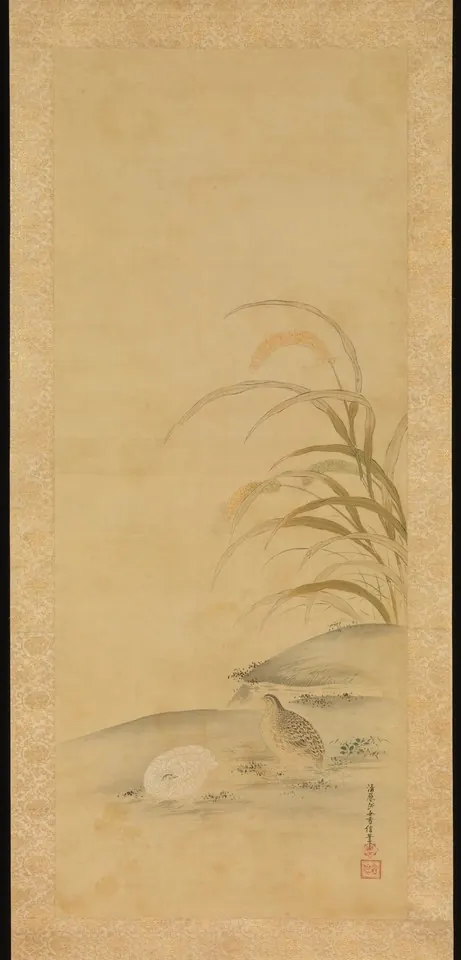
Two quails stand beneath heavy millet heads. Kiyohara Yukinobu painted this scroll in the later seventeenth century. A professional painter in Kyoto, she came from the Kanō artistic lineage and worked for the warrior elite. Her father, Kusumi Morikage, studied under Kanō Tan’yū, while her mother was that influential painter’s niece. Family connections provided access to training, models, and patrons.
The quail at the right stretches its neck. Small markings preserve the bird’s recognizable plumage, while the contour separates its rounded body from the ground. Yukinobu trained in several traditions, including Chinese bird-and-flower painting and Japanese narrative painting. Such education joined close depiction of nature with established compositions transmitted within a school.
The second bird, lower and to the left, has a more compact rounded form. The quails stand close together but turn differently. The Met proposes reading the pair as a wish for domestic harmony. In that interpretation, the small nature scene addressed the people whose home displayed the scroll. A familiar subject could convey a wish without an inscription giving direct advice.
The millet heads bend under their weight. Curving stems occupy the upper portion while the birds remain below. The plant suggests a season and gives the scene its vertical reach. Small animals inhabit an extensive setting that makes their size and available shelter apparent. Heavy seed heads, thin lines, and compact bodies organize the image.
A long leaf crosses the open field at the side. Yukinobu preserves ample unpainted silk, allowing individual plant lines to remain distinct. Quails with millet had a long history in Japanese painting, reaching back to twelfth-century Chinese academic models. She works with a prestigious inheritance while choosing her own balance between open space and detailed drawing.
The signature and seals stand beside the lower plant. They attach a familiar motif to a particular professional author. Yukinobu gained recognition during her lifetime and painted a much wider range than domestic subjects, including historical and mythological women from China and Japan. The birds’ meaning belongs to a chosen genre and patronage culture.
The scroll joins a centuries-old model with the career of a woman whose skills found patrons in Edo society. Family provided entry to the profession, but accomplished work required her own training and practice. The quiet bird scene carries this history of access to art. Behind a small natural motif stand a school, patronage, and a maker whose name survives.
- Medium
- Hanging scroll; ink and color on silk
- Collection
- The Metropolitan Museum of Art
- Dimensions
- 118.4 × 47.6 cm
- Accession number
- 36.100.45
Sources
Image provided under CC0. Image licence