Gibbons in a Landscape
Sesson Shukei · ca. 1570
Explore the painting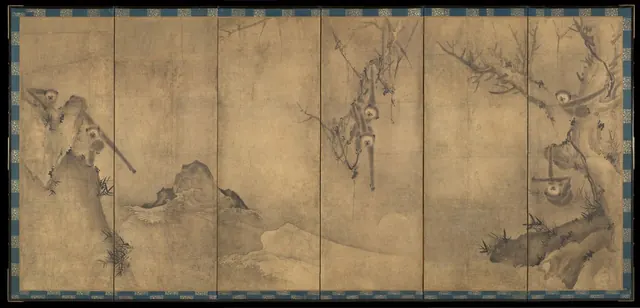
The gibbons on Sesson’s screen belong to both a landscape and a Buddhist parable. A chain of animals reaches toward the moon’s reflection in water. Trying to grasp a mere appearance became an image of delusion. Sesson, a painter and Zen monk, made these screens around 1570, drawing on Chinese ink painting. This is the right screen of a pair, each with six panels.
Gibbons hold one another to form a hanging chain. Long arms extend the movement beyond any single body. Their effort is collective, but its object remains unattainable. The parable addresses action itself: great effort and mutual assistance can still be governed by a mistaken idea.
A pale circle faintly marks the reflection below. The contrast between the bodies’ weight and the moon’s slight trace on water is central to the scene. The painter makes the goal almost insubstantial. It is difficult to notice at first, just as the animals misunderstand what they are attempting to hold.
Animals gather closely at the left, their dark bodies distinguished by turned heads and the positions of their arms. They are not abstract emblems of vice. Attention to animal behavior gives the parable appeal. The group invites interest and sympathy even as we understand the central chain’s error.
Curving branches support the upper action. Long brush movements continue through the gibbons’ arms, while soft ink washes suggest fur and moist air. Works by the thirteenth-century Chinese master Muqi reached Japan through monastic networks. Sesson develops this tradition at the scale of a screen that transforms a room.
Another group at the right extends the landscape beyond its central episode. The screen’s folds join and divide space. Changing their angles altered the apparent proximity of animals and trees. The story existed on an adjustable surface rather than on a single fixed plane.
The painting itself creates appearances of animals, water, and moon. The story of visual delusion itself depends on a painted world’s persuasiveness. The parable does not require us to stop looking. It invites a distinction between enjoying an image and assuming that what we see is already ours to possess.
- Medium
- Pair of six-panel screens; ink on paper
- Collection
- The Metropolitan Museum of Art
- Dimensions
- Image (each screen), 157.5 × 348 cm
- Accession number
- 1992.8.1, .2
Sources
Image provided under CC0. The right screen of a pair. Image licence