The Young Emperor Akbar Arrests the Insolent Shah Abu’l-Maali, Page from a Manuscript of the Akbarnama
Designed by Basawan, painted by Shankar · Mughal dynasty (1526-1857), c. 1590-1595
Explore the painting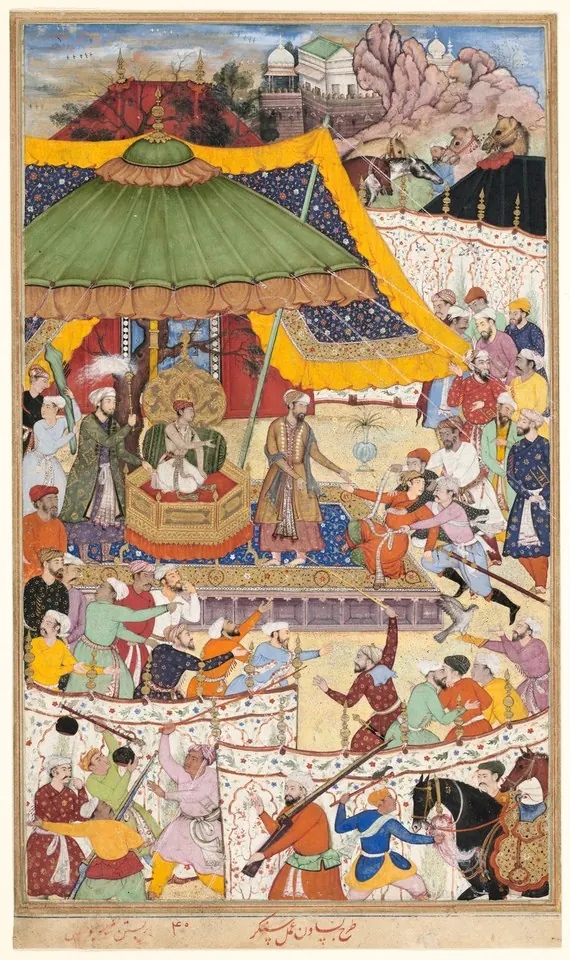
Thirteen-year-old Akbar has just taken the throne. Three days after his accession he orders the arrest of Shah Abu'l-Maali, a favourite of his deceased father, for disrespectful conduct. The image was made decades later for the Akbarnama, a history commissioned by the emperor himself. It recounts his youth while also recording how the mature court wished to preserve the beginning of his authority.
A large green canopy rises over the throne. Patterned fabrics surround it, with trees and buildings beyond: this is a garden encampment. Akbar spent much of his reign on the move, campaigning and administering an expanding empire. Temporary residence did not prevent the court from reproducing its ceremonial order of throne, attendants and rich furnishings.
Akbar sits on a golden throne and directs a hand towards the event. The young ruler occupies an elevated central position. A relatively small figure acquires authority through placement, entourage and gesture. The episode suits an account of his reign particularly well, presenting obedience as an issue settled in its first days.
The regent Bairam Khan stands before Akbar, connecting the seated emperor with the arrest. Basawan painted his face as well as those of Akbar and the disgraced courtier. He designed the composition and executed some of the landscape. An inscription below the picture helps reconstruct this division of labour.
Shah Abu'l-Maali, in red on the right, is restrained by several men. Hands seize his arms and clothing, turning a political decision into a physical action. The accusation of disrespect comes through the official court narrative. The image does not preserve the arrested man's own explanation of his conduct.
A crowd gathers below the platform. People raise their arms, turn and address one another. Carpet boundaries and screens divide the space into areas of different access. The commotion remains contained within a court hierarchy in which distance from the throne matters.
Rocks and pale pavilions appear above the tents. Basawan painted some of these passages; Shankar carried out the remaining work. The miniature records the collaborative practice of the Mughal atelier. Design, portraiture and execution could unite several makers on one sheet, although their names are not always preserved as clearly as here.
A figure in blue raises his arms near the lower edge. Weapons, a shield and horses recall the travelling court's military organisation. Our attention can move from these small actions towards the throne. Numerous observations give the scene immediacy, although the painters represented a past event they need not have witnessed.
The Akbarnama was commissioned in 1589. While the historian Abu'l Fazl wrote its text, around fifty artists produced the illustrations. Their organisation allowed literature and painting to construct a persuasive history of the reign. Close inspection invites a distinction between convincing details of everyday life and an impartial account of power. The former does not by itself guarantee the latter.
- Medium
- Opaque watercolor and gold on paper
- Collection
- Art Institute of Chicago
- Dimensions
- Image, 32 × 19.3 cm
- Accession number
- 1919.898
Sources
Image provided under CC0. Image licence
Adapted and translated from Art Institute of Chicago materials. · Text licence