King Anushirwan and the Owls, from the Khamsa of Nizami
Unidentified Iranian painters · Safavid dynasty (1501–1722), c.1535
Explore the painting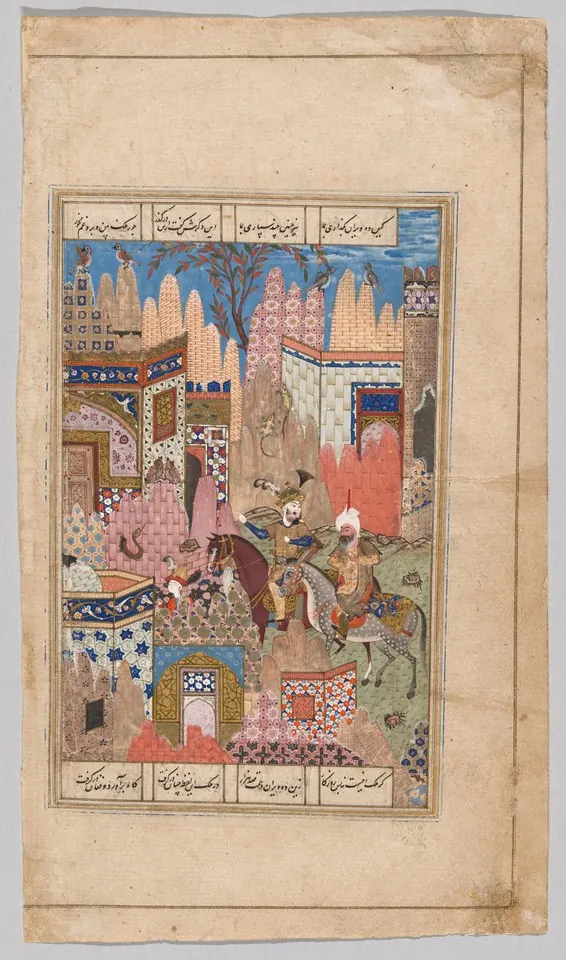
In Nizami's poem, King Anushirwan and his adviser become separated from a hunt and enter a ruined settlement. Hearing owls, the king asks what they are saying. The adviser explains that they are discussing a marriage payment. One owl promises numerous devastated villages if the ruler continues his present policies. Through this story, Nizami makes the king confront the consequences of his government.
Anushirwan rides a dark horse, gesturing towards the ruined buildings. The historical Sasanian king ruled in the sixth century; Nizami wrote several centuries later; this page was made around 1535 in Safavid Iran. Ruler, poet and painter belong to different periods. The miniature represents literary memory of the past.
The adviser in a white turban accompanies the king. His interpretation turns birdsong into a political warning. The device delivers an unwelcome truth indirectly. We cannot hear the words in the picture, but two riders among ruins establish the situation developed by the poem.
Two owls perch on a broken wall left of centre. They can easily be confused with other birds higher up, although this pair matters to the story. Ruined houses suit the owls, turning human disaster into an advantageous marriage bargain. The altered viewpoint makes the effects of bad rule especially apparent.
A tree rises among the buildings and small animals move across the rocks. The settlement remains a habitat for other creatures, although people are largely absent. Abandonment is conveyed without a separate scene of suffering. The inhabitants' absence becomes one of the image's principal events.
Walls are uneven, masonry is missing and rubble obstructs passages. Yet pink, blue and golden colours keep the page visually attractive. Devastation is represented with intricate workmanship and ornamental richness. This tension persists after the plot is explained: disaster can also hold our attention as a beautiful image.
Patterned surfaces remain on the walls, recalling the labour, resources and care once invested here. The painter does not show the settlement's destruction. Surviving ornament beside broken walls allows us to imagine a process, but no particular war or catastrophe can be named from the image alone.
Lines of poetry occupy framed rectangles above and below. The miniature belonged to a manuscript of Nizami's Khamsa, or Quintet, and the episode comes from its first book, the Treasury of Mysteries. Questions of justice and government are explored through instructive stories. Image and literary event belong together, rather than forming an independent view of historical ruins.
A luxurious book could remind an influential reader of the responsibilities of power. Another perspective remains possible. The dispossessed inhabitants do not speak for themselves: ruler, adviser and poetic birds explain their absence. We can consider whether that mediation strengthens the criticism or limits it. The painting preserves a question about governance without becoming documentary evidence for life in a particular village.
- Medium
- Ink, opaque watercolor, and gold on paper
- Collection
- Art Institute of Chicago
- Dimensions
- Image, 18 × 11 cm
- Accession number
- 1932.1366
Sources
Image provided under CC0. Image licence
Adapted and translated from Art Institute of Chicago materials. · Text licence