Zal Climbing to Rudaba, page from a copy of the Shahnama of Firdausi
Unidentified Iranian painters · Safavid dynasty (1501–1722), dated 1580/90
Explore the painting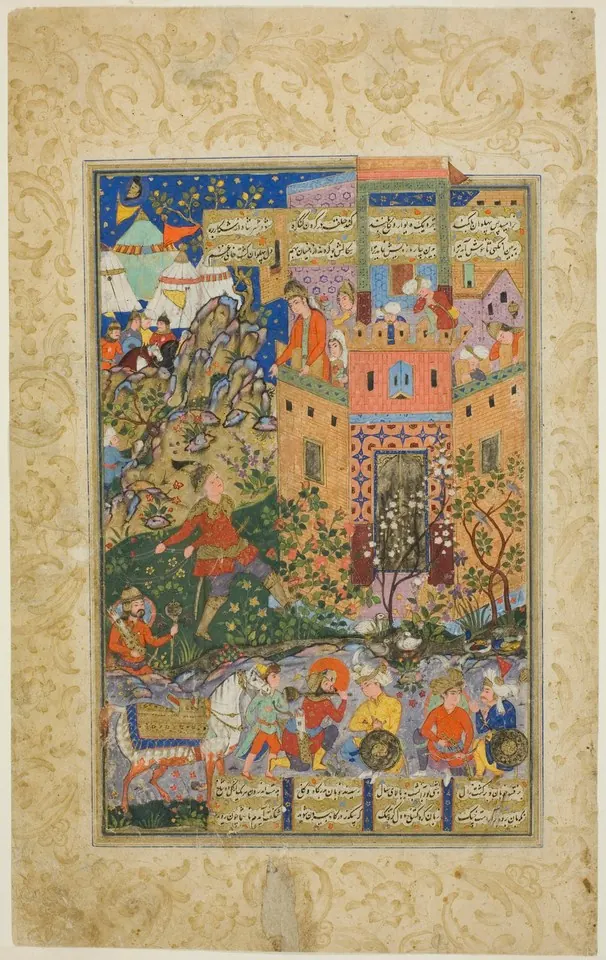
This late-sixteenth-century Persian Shahnameh leaf concerns Zal's encounter with Rudaba. The Book of Kings combines ancient rulers with heroic adventures and love stories. For a luxury manuscript's reader, the narrative existed in both verse and pictures. The miniature preserves the hero's approach to his beloved amid numerous people and objects. Their meeting takes place within a courtly world.
The red-clad figure beneath the wall turns towards the balcony. A raised leg and outstretched arms suggest movement towards the building. The lovers’ encounter requires overcoming the wall’s height. Red clothing among greenery and rocks makes this approach conspicuous on the small sheet.
People on the balcony lean over its enclosure. Gazes and gestures connect the upper and lower groups. The wall’s height makes the encounter a spatial problem. A crowded palace surrounds the lovers’ private feeling, placing their meeting before a courtly entourage.
Several sides of the building appear together. We see its façade, side wall and open upper rooms. This construction accommodates more events than a single fixed viewpoint. Architecture distributes participants across levels and helps us read a complicated page.
Blue decoration surrounds the dark entrance. The museum notes costly materials, including gold and blue pigment made from lapis lazuli. Their expense contributed to the manuscript's value. The pictured palace's richness echoes the luxury of the object held by a prosperous reader.
Armed figures with shields occupy the lower zone, extending the love episode into the world of heroic epic. Slender bodies, bright clothing and decorated weapons share the palace’s richness. The protagonists’ adventures belong to a courtly culture in which military prowess and trials of love form parts of one larger narrative.
A white horse stands out among bright clothing and rocks. Together with the tents, it links the palace to a wider world of travel and arrival. Plants and coloured stones fill the intervals, continually revealing another small grouping.
Lines of verse sit inside the picture. Light reserves accommodate the writing and coordinate it with the architecture. A museum viewer may admire the miniature without reading Persian, leaving part of the story inaccessible. Words and image complemented each other in the manuscript; this detached page cannot explain every cause and consequence of the encounter.
A personal encounter unfolds among warriors, courtiers and costly architecture. The page’s decoration repeats that world’s richness. Gold margins and lapis blue made reading the poem a distinctive experience for the owner of a luxury book. The detached leaf now lets us compare the lovers’ feelings with the social order surrounding and shaping their meeting.
- Medium
- Opaque watercolor and gold on paper
- Collection
- Art Institute of Chicago
- Dimensions
- 26 × 17 cm
- Accession number
- 1983.627
Sources
Image provided under CC0. Image licence
Adapted and translated from Art Institute of Chicago materials. · Text licence