Royal Horse Inspection
Ali Quli Jabbadar · Safavid dynasty (1501–1722), late 17th century
Explore the painting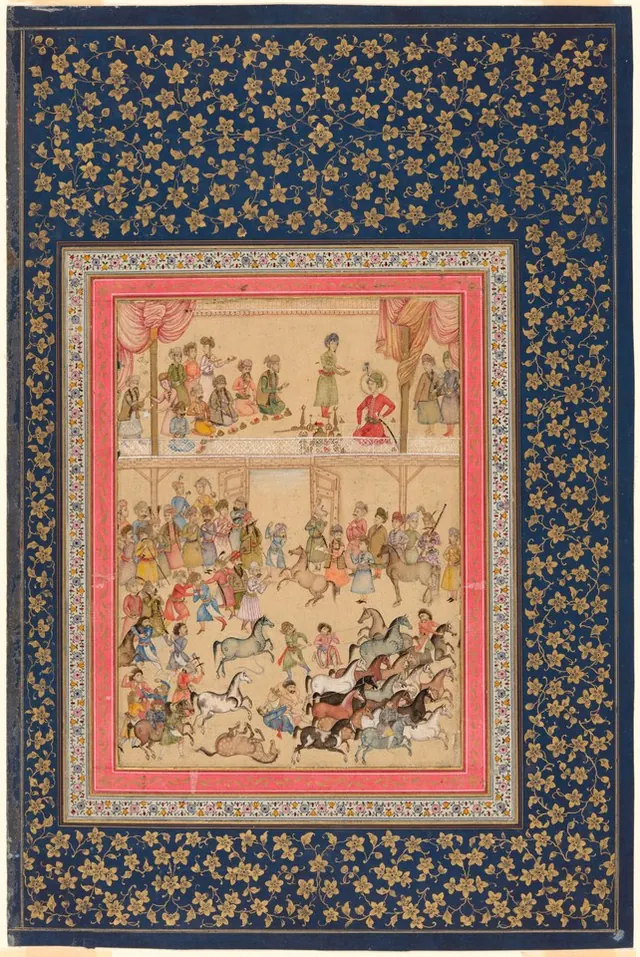
Below, men struggle to manage a herd of horses; above, the ruler sits with courtiers and refreshments. Ali Quli Jabbadar combines these activities on one page. The inscription identifies Shah Abbas II, who died in 1666, although the painting dates later. Its sense of immediate observation therefore does not make it a verified record of a single day in the shah's life.
The ruler sits on the platform beside the column on the right. A golden halo and precious vessels distinguish him. Attendants serve fruit and wine while courtiers kneel before him. The raised platform physically separates the court's ceremonial order from the commotion in the stables close below.
A man in a fur-edged sleeveless jacket holds a list and writes while speaking with a youth in blue. The museum suggests he may supervise the royal stud. His probable task clarifies the gathering's purpose: horses needed inspection and an inventory. An administrative procedure underlies the herd's lively movement.
The horses turn within a confined space. Their bodies overlap, but changing directions allow us to follow a circling movement. Royal brands appear on their flanks. Ownership is thus marked directly on the animals as well as represented by the wealthy court above them.
A dark blue field of gold flowers surrounds the small scene, with several coloured borders between ornament and image. The page rewards close inspection of people and animals. Lavish finishing preserves its courtly character even where the narrative concerns disorder and daily work.
Horses crowd the lower area. A brawl occurs on the left while other men continue handling animals. The painter includes incidents that resist an image of perfect ceremony. Such episodes give the work the character of observed life and distinguish it from a conventional assembly of motionless courtiers.
The column and the straight edge of the platform stabilise the upper composition. The figures taking refreshments seem largely unconcerned with events below. The two spaces sustain an account of court hierarchy. Some participants service and record its property; others attend the sovereign. Both belong to the same establishment.
In the later seventeenth century Persian painters increasingly introduced individual faces, everyday actions and small incidents into court imagery. The museum considers this work an example of that approach. The shah's name connects it with dynastic memory, while lists, brands and horse handling reveal the court's material organisation, usually absent from a formal royal portrait.
- Medium
- Opaque watercolor and gold on paper
- Collection
- Art Institute of Chicago
- Dimensions
- Page, 46.8 × 31.1 cm
- Accession number
- 1919.945
Sources
Image provided under CC0. Image licence
Adapted and translated from Art Institute of Chicago materials. · Text licence