Ksitigarbha Bodhisattva with Assembly
Unidentified Korean painters · late 16th/early 17th century
Explore the painting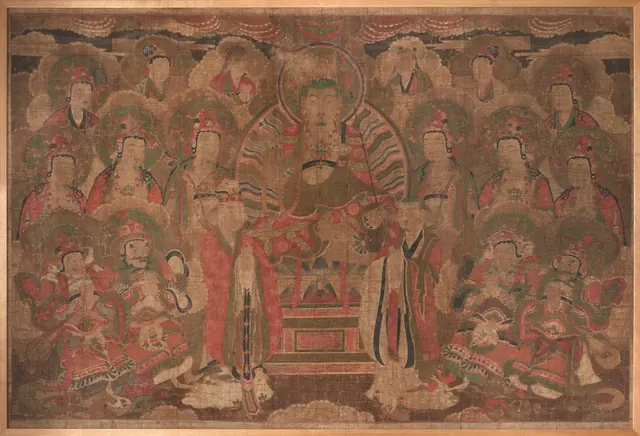
Kshitigarbha, known in Korean as Jijang Bosal, occupies the centre of this assembly. Buddhist devotees appealed to him for the salvation of beings suffering in the underworld. Kings of the afterlife and protective deities therefore gather around him. Recognisable figures and their positions make an otherwise invisible religious order available for devotional contemplation.
A halo surrounds Kshitigarbha's head. His central position and size immediately distinguish him from the accompanying figures. A bodhisattva follows the path towards awakening while helping other beings. Kshitigarbha's saving role was especially important to the widespread devotion he attracted in Korea.
Red and green passages of clothing recur around the centre. This shared palette connects numerous figures without erasing their differences. The museum relates it to changes in Buddhist patronage. As commissions extended beyond the royal court, affordable pigments and simpler treatment of robes became increasingly important.
A tall figure stands to the left of the central seat with hands joined. Its upright form frames Kshitigarbha and turns towards the assembly's centre. The figures are arranged in relation to the central being.
The standing figure on the right creates a corresponding boundary beside the seated bodhisattva. Position, size and costume help distinguish ranks. Symmetry makes this crowded image easier to navigate, securing the central group while many other figures retain their separate attributes at the sides.
Armed guardians occupy the lower left. Their emphatic faces and elaborate equipment differ from the calmer central image. Protection of the teaching and assistance to the dead belong to the same ensemble. For a devotee these complementary functions explain why such different beings appear together.
The guardians on the right correspond to those on the left without repeating them exactly. Turned heads, weapons and clothing introduce variation. Clear boundaries and limited foreshortening keep identifying features visible despite the number of figures.
A high seat elevates the central figure above the lower register. The painting itself is made on hemp cloth. Its support matters historically: alongside costly silk images, works on more affordable materials served patrons with different resources.
Buddhism enjoyed royal patronage under the Goryeo dynasty; its circumstances changed under Joseon. The museum connects more accessible materials and a predominantly red-and-green palette with the expansion of popular devotion. The patron of this particular painting remains unknown. Its surviving imagery reveals a religious need for salvation and protection without requiring an invented story about an individual owner. A less costly support also complicates familiar measures of artistic value. Should a religious image’s importance be judged by material expense when its devotees sought help? That question concerns our museum viewpoint. Hemp alone establishes neither a patron’s degree of faith nor a work’s artistic quality.
- Medium
- Ink and color on hemp cloth
- Collection
- Art Institute of Chicago
- Dimensions
- 155.6 × 230.5 cm
- Accession number
- 1920.458
Sources
Image provided under CC0. Image licence
Adapted and translated from Art Institute of Chicago materials. · Text licence