Portrait of Yun Dongseom (1710–1795)
Unidentified Korean painters · ca. 1790–1805
Explore the painting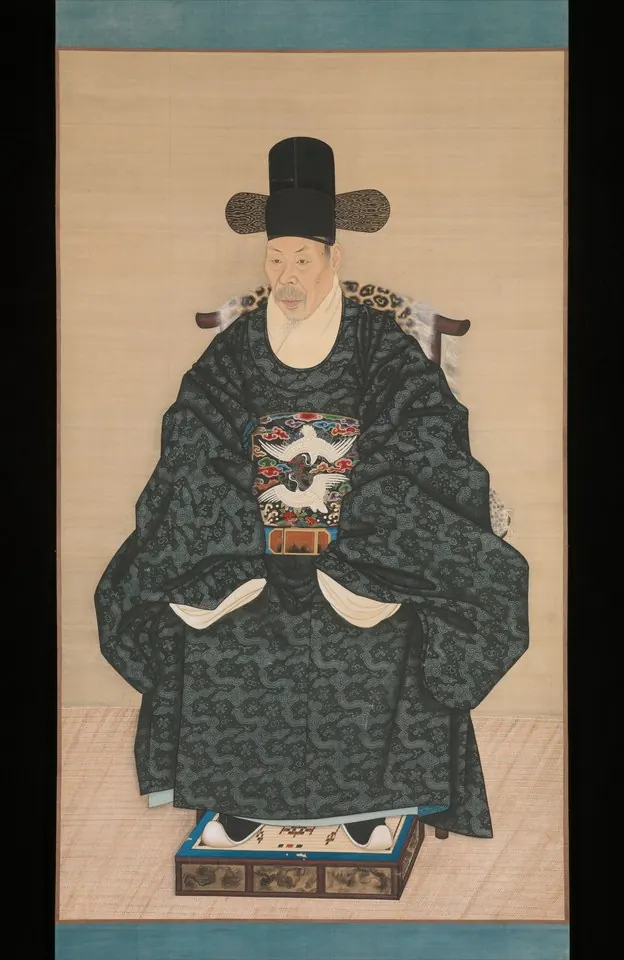
This is Yun Dongseom, a Korean scholar, calligrapher, and government official. He sits in formal dress on a high-backed chair. The portrait dates to approximately 1790–1805. Since Yun died in 1795, it could have been painted during his lifetime or soon after his death.
Wrinkles and variations in the skin individualize the face. A three-quarter turn reveals the farther cheek, with the eyes directed slightly aside. Comparison with two portraits in Korean collections established the sitter’s identity. Likeness thus plays a role in identifying him, rather than a name written on the front.
An embroidered badge with two white cranes appears on the chest. Formal clothing represented a person’s place in the state hierarchy. The blue robe fills most of the lower portrait. An individual face is surrounded by a system of public distinctions that a modern viewer must learn to interpret.
The belt helps establish a date. The museum identifies rhinoceros horn and gold, materials associated with officials of the second rank and above. Yun attained that rank in 1790.
Spotted leopard skin covers the chair behind the shoulder. Its dense pattern contrasts with the robe’s broad surfaces. The nearly empty background limits the setting to chair and footrest. There is no description of everyday office work; this is a carefully arranged presentation of a man in his official capacity.
The feet rest on a footstool and the hands are concealed within sleeves. The restrained pose suits an image intended for lasting reverence. In Neo-Confucian Korea, portraits of this kind could be housed in family shrines and used in ancestral rites, maintaining descendants’ ties to the male lineage.
In a family shrine, descendants would encounter Yun in his elevated rank. Age, formal clothing, and a composed pose established ancestral dignity. Such remembrance supported the male lineage and transmitted the prestige of government service. Individual likeness preserved a face, while the formal presentation established its place in family history.
- Medium
- Hanging scroll; ink and color on silk
- Collection
- The Metropolitan Museum of Art
- Dimensions
- Image, 133 × 77.2 cm
- Accession number
- 2014.605
Sources
Image provided under CC0. Image licence