Water-moon Avalokiteshvara
Unidentified Korean painters · first half of the 14th century
Explore the painting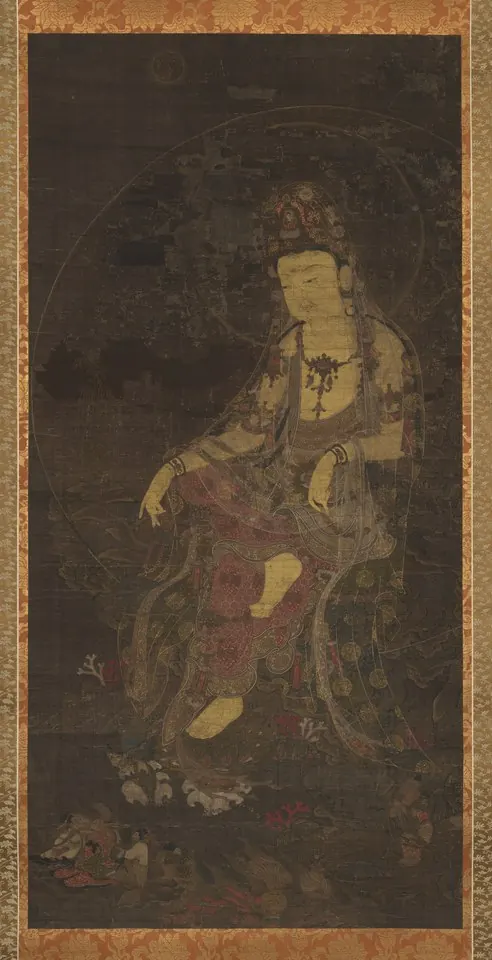
The young pilgrim Sudhana has come to seek teaching from Avalokiteshvara, the bodhisattva of compassion. Their encounter is described in the Buddhist Avatamsaka Sutra. An unidentified fourteenth-century Korean painter transformed the episode into an image for devotion. During the Goryeo period, worshippers sought this deity’s protection against illness and calamity, including dangers encountered while travelling.
The face occupies only a small part of the tall figure yet draws attention through its pale colour. Lowered eyes and a slight turn of the head are directed towards the bottom of the scroll. From the large image we can gradually move to the tiny visitors at the foot of the rock. Their difference in size establishes the sacred scene’s hierarchy.
Sudhana stands at the lower right. He requires a careful search, since he is tiny beside the bodhisattva. Knowing the story gives the viewer an entry into the image. The pilgrim’s journey leads to this encounter, while the painting’s arrangement allows us to follow his attention towards the figure above the sea.
Another group approaches at the deity’s feet on the left. The museum identifies its leader as the dragon king; sea creatures bring gifts. Vessels, elaborate garments, and unusual bodies can be distinguished among them. This small episode expands the setting, joining the human world with beings from the depths of the sea in an act of devotion.
Gold patterns cover the clothing. Fine lines trace folds, jewellery, and the edges of a transparent veil. Close inspection reveals how many distinct surfaces are contained within one figure. A pale contour continues its course even where the fabric’s colour has darkened and no longer separates clearly from the background.
The artist worked on semitransparent silk, applying pigments to both sides to intensify colour and luminosity. Some pigments have since faded through exposure to light, so the darkened surface does not fully convey the original colour relationships. The surviving reds around the knees and delicate gold lines are particularly useful to follow.
High above the figure a small circle of moon is barely visible. The title Water-moon connects this small celestial sign with the sea below. The great circle behind the bodhisattva serves a different role, distinguishing the sacred figure. The two circles should not be confused when reading the image as a whole.
A modern viewer may notice the luxurious clothing and skilled drawing first. For a worshipper the same surface served another purpose: the image was approached for help. Neither an artistic nor a religious reading exhausts the object. Their difference becomes particularly apparent when a devotional image enters a museum or appears on a screen.
The painter’s name has not been established. Much about the work nevertheless survives: the choice of silk, painting on both sides, gold drawing, and a complex hierarchy of figures. These all served a religious purpose. A worshipper encountered a story of meeting and assistance expressed through a painstakingly made object.
- Medium
- Hanging scroll; ink and color on silk
- Collection
- The Metropolitan Museum of Art
- Dimensions
- Image, 114.5 × 55.6 cm
- Accession number
- 14.76.6
Sources
Image provided under CC0. Image licence