The Tower of Babel
Pieter Bruegel the Elder · 1563
Explore the painting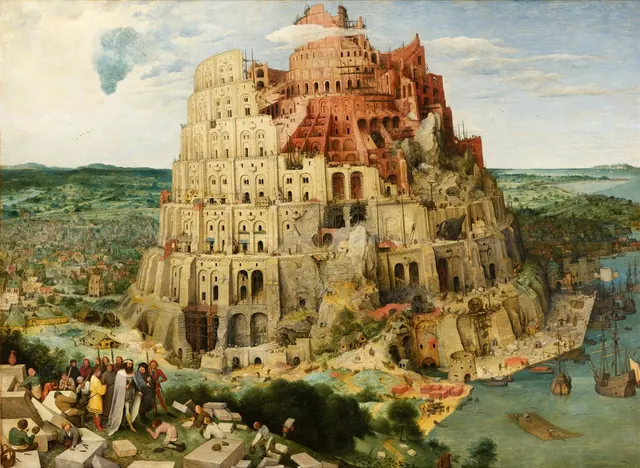
Bruegel’s Tower of Babel resembles a construction project that has absorbed an entire city. It was painted in 1563. In Genesis, people sharing one language decide to build a city and a tower reaching heaven to establish their name. God confuses their languages, and construction stops. Bruegel chooses a moment when the enormous enterprise is still operating. The story tells us of its eventual failure; the painting shows us work.
Tiers of arches rise around a rocky foundation. Some walls already have pale stone facing, while red inner volumes remain exposed nearby. Different stages of construction appear simultaneously. The tower almost becomes a city of roads, rooms and workshops stacked above one another. Its scale is astonishing, but continuous work on separate parts makes a completed building difficult to imagine.
In the foreground workers kneel before a ruler and his entourage. The museum identifies him as Nimrod. He is not named in the biblical episode of the confusion of languages; his association with the tower belongs to another tradition, including Josephus. Bruegel adds relations of subordination to the collective enterprise. Some command while others interrupt their work to pay respect.
Ships, boats and cargo gather beside the water. Construction depends on material deliveries, making the harbour part of the subject itself. Viewers from the trading Netherlands would recognise such a scene. The biblical setting acquires the infrastructure of a major European port. Ancient ambition becomes connected to contemporary possibilities of commerce, transport and organising large numbers of people.
Upper walls end in irregular edges, with scaffolding rising above them. Lifting mechanisms and small groups work below. Up close, the imposing mass breaks down into numerous technical tasks. There is reason to admire the builders’ skill here. A story of punished pride does not require the painter to make their work seem meaningless or incompetent.
Ordinary houses at the foot provide a measure for the tower. They look tiny, though together they form a large city. The immense structure pushes everyday life towards the painting’s edges. Who owns such an achievement: a ruler seeking glory, or the workers and inhabitants who sustain it? Scale makes this question visible.
The moralising subject and the detailed picture of cooperation pull our attention in different directions. We expect unity to break down, yet a complex system of interdependence still operates before us. Catastrophe will mean more than punishment for the ambitious. Cooperation sustaining an entire city will cease. A story about the limits of human power also becomes a reflection on the fragility of a shared undertaking.
- Medium
- Oil on oak panel
- Collection
- Kunsthistorisches Museum, Vienna
- Dimensions
- 114.4 × 155.5 × 3.8 cm
- Accession number
- Gemäldegalerie 1026
Sources
Reproduction of a public-domain artwork. Image licence