The Annunciation
Jean Hey, Master of Moulins · 1490–95
Explore the painting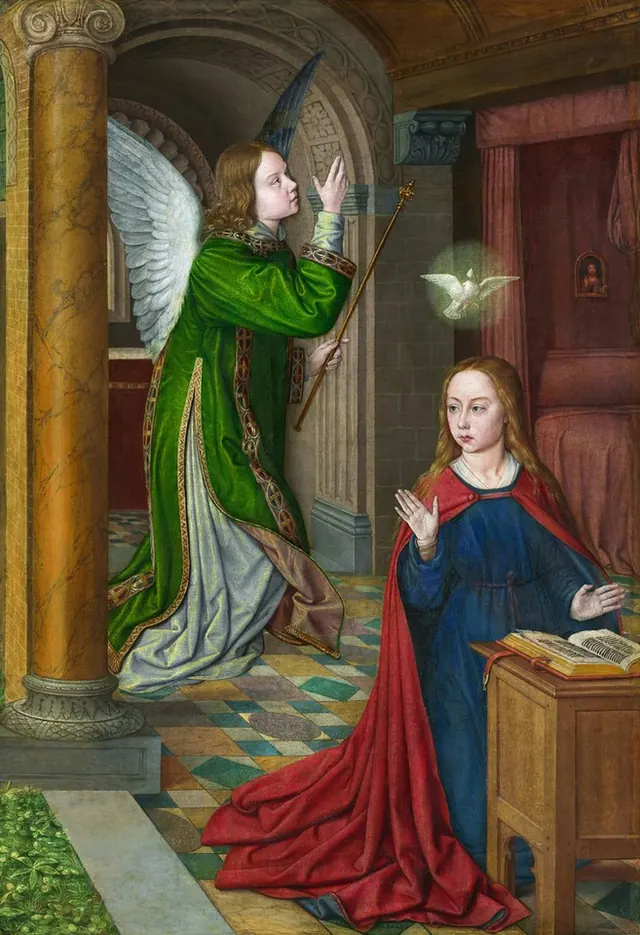
An angel tells Mary that she will become the mother of Christ. Jean Hey places the Annunciation in a richly finished room, where attention to marble, fabric and a book brings the sacred event close to domestic experience. The image was not always independent, however. It is the right section of a dismantled altarpiece; the left survives in London and the centre is lost. Separation changed the meaning we encounter.
Gabriel addresses Mary with a raised hand and a staff. His movement ends where her response begins. In Christian narrative, this is the moment of Mary’s acceptance of God’s plan. The painter presents an exchange between figures whose positions differ but whose hands and gazes connect them.
A pale wing opens against the stone vault. Its tiny, carefully differentiated feathers recall northern European painting and manuscript illumination. Jean Hey worked at the Bourbon court in France. His art combined close attention to materials with the ceremonial character of courtly religious patronage.
Gold decoration borders the angel’s green garment. Precious textiles mattered within the sacred image and to its patron. An altarpiece expressed devotion through an expensive, meticulously made object. Prayer, family remembrance and the display of standing could coexist in the same commission.
Mary kneels by a book. The London fragment shows her parents, Joachim and Anne, meeting after receiving the promise of a daughter. The scenes connect Mary’s conception with Christ’s incarnation. Historians suggest a link to Anne of France, Duchess of Bourbon, who gave birth to Suzanne in 1491 after a long marriage.
The white dove between the figures represents the Holy Spirit. It occupies a luminous passage that distinguishes the supernatural appearance from the material room. This small figure connects Gabriel’s message to the Christian understanding of the event. Above Mary, it establishes a vertical direction within the largely horizontal exchange of gestures.
The open book rests on a wooden lectern. Such domestic details brought Gospel history close to the experience of praying before the altarpiece itself. The reading Virgin offered an example of concentrated devotion. The costly blue pigment in her clothing also records the material resources invested in the image.
A column stands to the angel’s left, but another figure once occupied that edge. X-radiography revealed a person scraped away and overpainted before 1906. One reconstruction identifies him as Saint Louis. The alteration helped the fragment appear complete while concealing some of its original connections.
If the altarpiece was an offering of thanks for Suzanne’s birth, the Annunciation joined Christian history to a particular family’s hopes. The surviving scenes and Bourbon devotional interests support this interpretation, though the original purpose remains uncertain. Museum separation now offers another experience: each fragment can be admired individually, at the cost of the whole.
- Medium
- Oil on panel
- Collection
- Art Institute of Chicago
- Dimensions
- 72.5 × 50.1 cm
- Accession number
- 1933.1062
Sources
Image provided under CC0. Image licence
Adapted and translated from Art Institute of Chicago materials. · Text licence