The Red Studio
Henri Matisse · Fall 1911
Explore the painting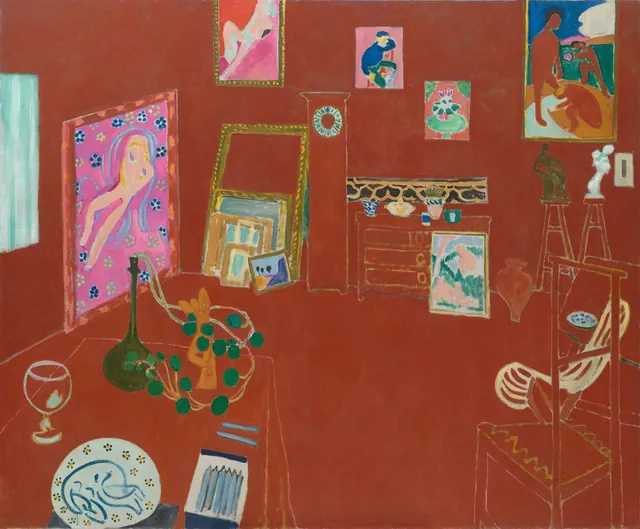
In 1911, Matisse painted his own studio at Issy-les-Moulineaux outside Paris. His paintings, sculptures and ceramics fill the room. The work was intended for the collector Sergei Shchukin, who did not acquire it. Almost the entire interior shares one red colour, yet objects remain distinguishable and the room retains depth. Matisse explores how few familiar cues are needed to recognize a space.
The clock is recognizable from its round face and tall case, although no hands are visible. Thin pale gaps left within the red define its body. The picture gives no basis for inventing a particular arrested hour. It does reveal another decision clearly: an object can survive through its outline and a few necessary features even when almost all its individual colour is removed.
A large pink painting stands against the left wall. Its colours survive within the red surroundings, as do those of the other artworks. Technical examination established that the floor was originally pink, the walls blue and the furniture ochre. The red layer came later. One sweeping revision changed the relationships between already painted objects, making the works of art particularly prominent.
The green vase on the foreground table has a solid silhouette. The table itself is much more schematic, its far edge almost disappearing. Yet the arrangement of vase, glass and plate reconstructs the tabletop. We recognize the furniture through the objects it supports. Red unites wall and table while the placement of things keeps them distinguishable.
Other works by Matisse appear along the back wall and beside the chest of drawers. It is a collection of images within an image, spanning different media and sizes. Researchers found that he used the same pigments as the originals for some of the paintings depicted. His works are therefore present as recognizable subjects and as specific colour materials.
A wicker chair stands on the right. Its curves and sloping legs tell us how it sits in the room although the same red passes through almost the entire object. Pale bands describe the seat while fine lines indicate the frame. Their difference separates the two structures. Matisse allocates detail according to what recognition requires.
Pencils and an open box lie near the bottom edge, recalling the room’s purpose. Images are made in a studio, and Matisse shows the results alongside working tools. The artist himself is absent, but his presence is established through tangible things. The selection of objects occupying the room provides that evidence.
Matisse kept the painting for sixteen years. It later went to London’s Gargoyle Club and entered MoMA in 1949. Its long journey shows that recognition of an artistic decision can come well after its creation. Today the red layer makes it particularly clear that we are seeing both a room containing objects and a flat surface on which the artist arranged them. The artist himself is absent. Selected works and objects take his place, allowing the interior to be read as an indirect self-portrait. That is an interpretation. What image of work does it offer? There are traces of making, but little disorder. Matisse presents a space in which his pictures already form a carefully arranged environment, almost a personal collection.
- Medium
- Oil on canvas
- Collection
- Museum of Modern Art, New York
- Dimensions
- 181 × 219.1 cm
- Accession number
- 8.1949
Sources
Reproduction of a public-domain artwork. Image licence