Woman before an Aquarium
Henri Matisse · 1921–23
Explore the painting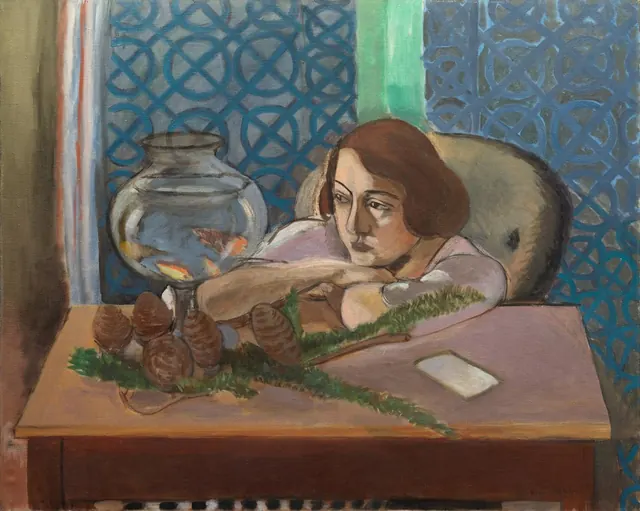
Henriette Darricarrère rests her head on folded arms beside an aquarium. Matisse painted her in Nice in the early 1920s. A former dancer, she was a regular model appearing in varied costumes and poses. This calm interior was arranged for painting. Person, objects and patterned fabric form a scene with little external action but continuous movement of attention.
Henriette’s face turns towards the fish. Her head rests on her arms and her shoulders are lowered. The pose may suggest rest or fatigue, but it could also belong to a sitting. We see a position chosen for the painting. It lets us imagine a mood without revealing what the model actually felt.
The round aquarium stands nearly level with her face. Glass separates a small aquatic world from the room while displaying it. Matisse repeatedly returned to goldfish. Their movement beside a motionless sitter introduces another pace within the picture.
Orange fish stand out against blue-grey surroundings. A few warm patches concentrate attention within a small area. Matisse’s interest in intense colour persists, although the overall palette is quieter than in his early Fauvist works. Colour can exert force through a small accent.
Folded arms create a horizontal support beneath the chin. Their line repeats the tabletop and connects figure with still life. The pose is arranged as carefully as the vessel. Professional work by a model helps construct an image of leisure.
A conifer branch and cones lie on the table. Natural forms join an artificially maintained aquatic world. Their matt surfaces differ from smooth glass. The room gathers small fragments of nature for attentive looking.
Blue textile patterns fill the background. Matisse collected fabrics and studied Islamic art; visits to Morocco in 1912–13 durably affected his work with light and ornament. In Nice those experiences became specially arranged interiors. Distant cultural encounters acquired a new studio function.
A small pale rectangle interrupts the dense group of plants and objects. The empty tabletop beside it gives the eye a pause. Matisse distributes full and open areas, providing a sequence of attention within an almost motionless scene.
The painting may resemble an unmediated slice of life, although artist and model created its conditions. North African impressions, a European studio and collected objects form an image of repose. It contains creative exchange as well as the painter’s freedom to remove things from their original settings. The calm room retains histories of people, motifs and objects in motion.
- Medium
- Oil on canvas
- Collection
- Art Institute of Chicago
- Dimensions
- 81.2 × 100.2 cm
- Accession number
- 1926.220
Sources
- Art Institute of Chicago — Woman before an Aquarium
- Museum data and bibliography — Woman before an Aquarium
- Matisse catalogue — Woman before an Aquarium, Henriette and the Nice interior
- The Met — Henriette Darricarrère, former dancer and Matisse’s model
- AIC — Matisse, textiles and North African encounters
Image provided under CC0. Image licence
Adapted and translated from Art Institute of Chicago materials. · Text licence