The Starry Night
Vincent van Gogh · June 1889
Explore the painting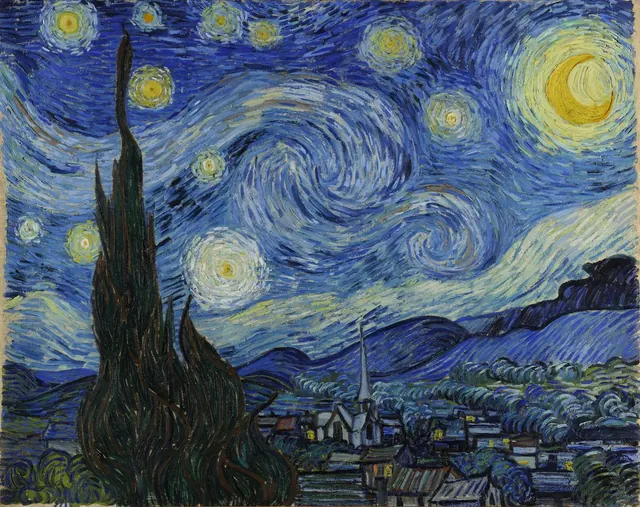
In June 1889, Van Gogh was living and receiving treatment at Saint-Paul-de-Mausole near Saint-Rémy. He watched the countryside before dawn from his window and wrote to his brother Theo about an especially bright morning star. He painted The Starry Night during the day, over several sessions. Observation and the finished picture were separated by a process of selection, recollection and revision.
The cypress almost reaches the upper edge. Van Gogh brought it closer than it appeared in the actual view, so that it now overlaps hills, houses and stars. Long curved strokes remain visible within its dark silhouette. They follow the branches upwards and connect the lower picture with the sky. The tree has a clear compositional role even without assigning it an additional symbolic meaning.
Broad yellow bands spread around the moon, alongside short blue strokes following the same direction. Light has acquired a visible shape of its own. Instead of leaving a star as a tiny point in the distance, Van Gogh spreads its radiance across the canvas. The celestial bodies consequently have a visual force comparable to the dark tree in the foreground.
A pale band curls across the middle of the sky. Following individual strokes reveals how the brush direction reinforces each bend. MoMA identifies the bright body left of centre as Venus, the morning star mentioned in the letter. Yet that recognizable celestial object sits within a freely constructed pattern. The picture combines a specific observation with a rhythm made by the artist.
The village and its tall church could not be seen from the asylum window. Van Gogh constructed them from other impressions. Roofs, walls and illuminated windows make this area easier to recognize than the immense sky. The steeple supplies another vertical beside the cypress. The settlement establishes the landscape’s scale and keeps a human presence within the picture.
The hills form several undulating bands. Their outlines continue the sky’s movement, although the lower colours are darker and the shapes more compact. Straight rooftops sit between the curves of land and sky. Van Gogh varies the character of his lines from area to area to organize the complex image. Up close, we see the brushwork; from a distance, those same strokes become terrain and illumination.
The Starry Night is often explained through Van Gogh’s illness. His stay in the asylum certainly shaped his working conditions, but the canvas also reveals deliberate artistic decisions. He enlarged the tree, constructed the village, altered the stars’ radiance and coordinated his strokes. Colour and form allow a landscape to convey an observer’s experience, a possibility that many twentieth-century painters would continue to explore. The cypress screens part of the sky, while roofs crowd into a narrow band below. One viewer may find shelter in this relationship; another may see the settlement’s vulnerability within immense space. The scale and placement of forms offer grounds for both readings. They cannot identify a single state of mind belonging to Van Gogh. His painting accommodates human shelter and a scale beyond human control.
- Medium
- Oil on canvas
- Collection
- Museum of Modern Art, New York
- Dimensions
- 73.7 × 92.1 cm
- Accession number
- 472.1941
Sources
Reproduction of a public-domain artwork. Image licence