Self-Portrait
Vincent van Gogh · 1887
Explore the painting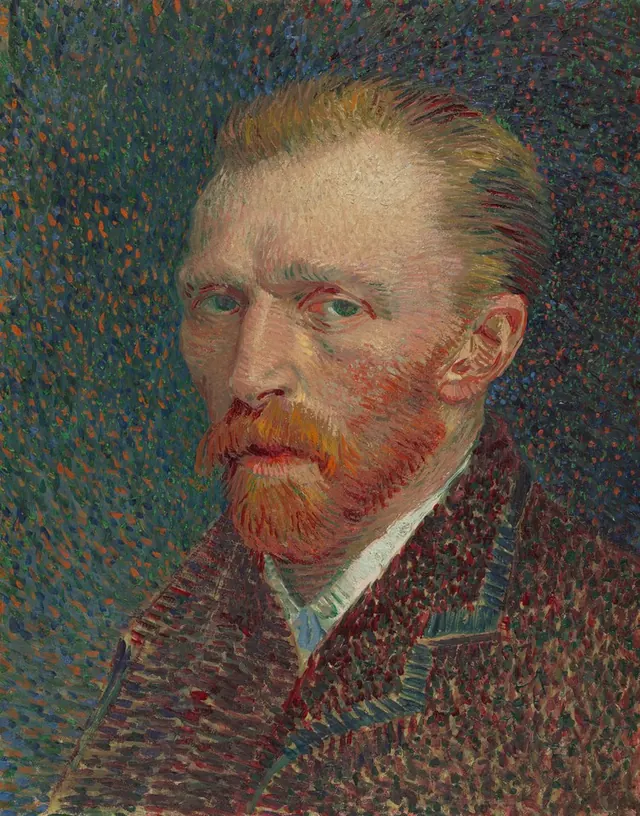
In 1886 Van Gogh moved to Paris, where his brother Theo dealt in paintings. Encounters with Impressionism and new artists changed his palette. Over two years he produced at least twenty-four self-portraits, making his own face a recurring subject of study. This small work of 1887, painted on prepared artist’s board, retains the character of a concentrated experiment.
Green eyes retain clear outlines among the broken touches. In a letter to Theo, Van Gogh placed human eyes above cathedrals as a subject of interest, connecting them with people’s inner lives. Here the gaze becomes a stable centre within an active surface. Its clarity makes the freer treatment of surrounding features particularly apparent.
Red, orange and greenish strokes construct the beard without fully blending on the surface. At a distance they combine into volume; close up they become separate touches again. Enlargement changes our way of seeing, from a recognisable face to decisions about adjacent colours.
Longer directional strokes describe the hair. They follow its growth before meeting a differently organised background. In Paris Van Gogh encountered Seurat's method of separate coloured dots. Here he freely varies the brush mark, using dots, short lines and longer strokes.
Red outlines the ear against paler skin. Green and yellow passages inside help construct its volume. The same colours recur in beard, hair and clothing. Repetition connects the portrait’s parts, while changing stroke directions distinguish skin, hair and fabric. One palette performs several different tasks.
The white collar separates neck from dark clothing. Its triangular form stabilises shoulders and head among numerous marks. Even while experimenting with divided colour, the artist retains structural boundaries that prevent the surface from fragmenting into unrelated patches.
Red, blue and green touches cover the jacket. An area that might otherwise become a single dark mass remains active with colour. Marks on the lapels run differently from those on the chest. Direction helps distinguish the fabric's shape despite colours unexpected in an ordinary suit.
The museum compares this portrait with Seurat’s pointillism, especially A Sunday on La Grande Jatte. Separate dots organise many figures in that large leisure scene; Van Gogh brings the approach to his own face and changes the brush mark’s shape. An apparently solitary image thus reveals an exchange with a contemporary. Self-portraiture becomes a way to test what another painter’s discovery can contribute to an individual style.
- Medium
- Oil on artist's board, mounted on cradled panel
- Collection
- Art Institute of Chicago
- Dimensions
- 41 × 32.5 cm
- Accession number
- 1954.326
Sources
Image provided under CC0. Image licence
Adapted and translated from Art Institute of Chicago materials. · Text licence