Self-Portrait with a Straw Hat (obverse: The Potato Peeler)
Vincent van Gogh · 1887
Explore the painting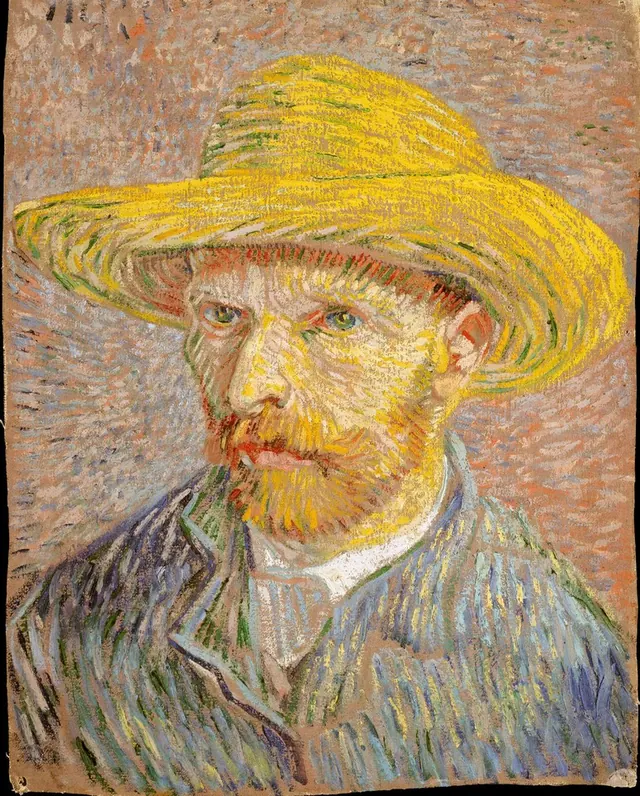
Van Gogh painted himself in a straw hat in Paris in the summer of 1887. Living with his brother Theo, he encountered Impressionist and Neo-Impressionist painting. He made more than twenty self-portraits during his two Paris years. His own face provided an available model when money for sitters was scarce. Repetition allowed changes in lighting, color, and brushwork to be tested on a familiar subject.
The bright yellow hat occupies much of the upper head. Green and pale strokes follow brim and crown, retaining a woven structure. Adjacent colors build the surface. Paris changed Van Gogh’s palette. Forms previously handled through broad dark masses now received numerous small, light distinctions.
White, pink, yellow, and greenish strokes spread across the cheek following its form. Paint retains the brush’s movement. Van Gogh studied Seurat and Signac’s division of color into separate touches, but these marks are elongated and change direction. They describe lighting, cheekbones, and the rhythm of the working hand at once. A recognizable face emerges from an openly constructed surface.
The eyes face the viewer. In a self-portrait, such a gaze relates to looking at oneself in a mirror. During the work, one person alternates between observer, sitter, and maker. Today the gaze is often read through knowledge of the artist’s later life. In the summer of 1887, however, this canvas belonged to his practical study of a new way to paint faces.
Short yellow, orange, and green strokes build the reddish beard. A white collar and blue-green jacket change the skin’s chromatic surroundings. Contrasts are distributed throughout the figure. The vivid hair belongs to an experiment in which neighboring paints strengthen or soften one another’s effects.
Blue and pink-ochre marks alternate in the background. The brush is as active behind the head as on face and clothing. The reverse carries the earlier Potato Peeler, painted in a dark manner in 1885. Reusing the support saved materials. The two sides of one object preserve unusually direct evidence of a change in pictorial language.
The portrait shows how Van Gogh’s learning depended on encounters with other art, available materials, and repeated practice. A personal image emerged within a professional investigation. Comparing the canvas’s two sides complicates the familiar story of solitary genius. We see specific decisions by a painter trying new methods, returning to his own face, and using a support already at hand.
- Medium
- Oil on canvas
- Collection
- The Metropolitan Museum of Art
- Dimensions
- 40.6 × 31.8 cm
- Accession number
- 67.187.70a
Sources
Image provided under CC0. One side of the work is shown. The reverse is not included. Image licence