Impression, Sunrise
Claude Monet · 1872
Explore the painting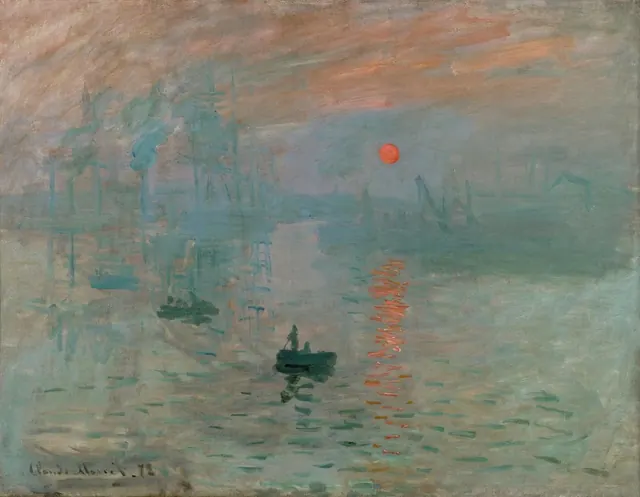
In November 1872 Monet looked from a hotel window across the port of Le Havre. Before him lay the harbour, quays and structures of a major trading city. According to the Musée Marmottan, the painting took a few hours. Two years later it appeared at an independent exhibition in the photographer Nadar’s former studio. The word impression in its title helped critics name a new movement, initially in mockery.
The sun is a small orange circle. There is little internal shading to make it appear solid. It stands out chiefly through colour against the cool atmosphere. The relationship between two colour areas becomes more convincing than a detailed shape. To recognise dawn, we need not inspect the solar disc as precisely as an object close at hand.
The reflection consists of short orange strokes separated by water. They never form an even band. Their varying lengths and directions suggest surface movement while the solar disc remains still. Compare this trail’s density with the more transparent painting around it. A few conspicuous brush movements establish the lighting of an entire space.
A dark boat carrying two people lies nearest to us. More distant boats become paler and less distinct. Depth emerges without elaborate perspectival construction. These small craft belong to a working port. They also establish scale: without people and boats, the coloured bands would be harder to connect to actual distances.
Masts, chimneys and lifting structures emerge beyond the water. Mist merges their outlines, but the industrial city remains inside the landscape. Today the picture can easily look like a peaceful view of nature. Staying with the distance reveals something else: dawn illuminates the infrastructure of trade. A modern port supplies both Monet’s subject and a complex setting for observing light.
Sky and water use related greys, blues and pinks. The horizon never becomes a hard boundary. Air and wet surface seem to continue one another, though brush direction helps distinguish them. Monet reduces the description of things to convey an overall condition of visibility. This apparent lack of finish could irritate viewers expecting meticulous completion in an exhibition painting.
In April 1874 Louis Leroy mocked the show as the Exhibition of the Impressionists; soon afterwards Jules Castagnary used the same word positively. The dispute concerned what counted as a finished painting. Could a rapidly changing observation require different handling from a stable object? The new name’s success shows how a critic’s judgement can transform the fate of an artistic method, even when it initially seeks to diminish it.
- Medium
- Oil on canvas
- Collection
- Musée Marmottan Monet, Paris
- Dimensions
- 50 × 65 cm
- Accession number
- 4014
Sources
Reproduction of a public-domain artwork. Image licence