Houses of Parliament, London
Claude Monet · 1900–1
Explore the painting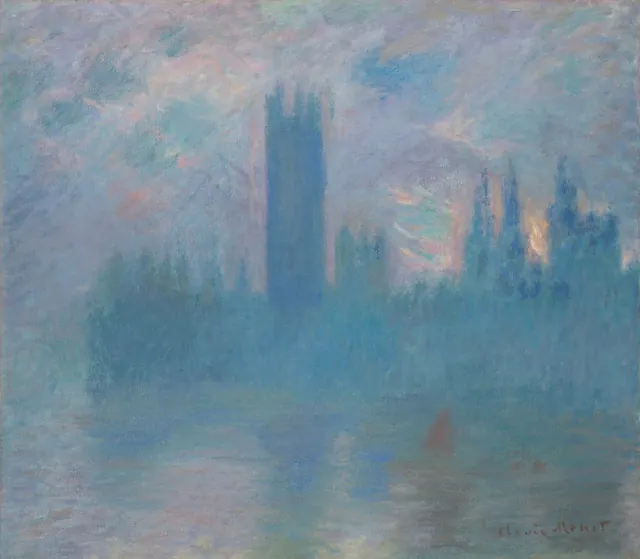
Monet viewed the Palace of Westminster from a terrace at St Thomas’s Hospital across the Thames. In the evening the building stood against the light, while moisture obscured its details. This painting of 1900–1901 belongs to his London series. Recognisable architecture let him repeatedly explore how much an object changes when the conditions of seeing it change.
The principal tower emerges as a relatively solid silhouette within the blue. Technical examination showed that Monet reinforced it after earlier layers had dried. Additional paint gave the building greater stability. He adjusted the boundary between recognition and dissolution into air.
The towers on the right become thinner and more fragmented. Vertical strokes preserve their Gothic profile, but window details almost disappear. The stone building seems less substantial than its familiar civic image. This is particularly striking in the British Parliament building, commonly perceived as a sign of institutional stability.
Pink and yellow passages shimmer between the spires. Monet arrived in a city with an established history of Thames imagery. His viewpoint was close to the one Turner used for the fire that destroyed the old Parliament in 1834. Whistler’s soft twilight views were especially important to his own response to London’s atmosphere.
The left side of the building nearly matches the water and sky in tone. Their closeness makes air the principal condition of visibility. We recognise Parliament from a few persistent forms and reconstruct the rest. The complete building continues to exist, but the painting offers only what light and haze permit us to see.
A boat appears as a warm patch at the lower right. Monet revised this area with the water and reflections. The earlier boat occupied a slightly different position, and traces survive beneath the surface. The small vessel relates immense architecture to everyday movement on the river.
Horizontal blue and pinkish strokes describe the water. Conservators found that some red pigments had faded while retaining colour beneath the frame edges. The painting’s present coolness partly belongs to its material history. We see both Monet’s chosen state of the Thames and the ageing of his paint.
Monet signed the canvas twice in approximately the same place, returning after an initial finished version. The apparent instant of sky and water therefore contains prolonged work. Parliament remains recognisable but ceases to be a fixed sign. Its image depends on atmosphere, painterly decisions and the time elapsed since it was made.
- Medium
- Oil on canvas
- Collection
- Art Institute of Chicago
- Dimensions
- 81.2 × 92.8 cm
- Accession number
- 1933.1164
Sources
Image provided under CC0. Image licence
Adapted and translated from Art Institute of Chicago materials. · Text licence