Water Lilies
Claude Monet · 1906
Explore the painting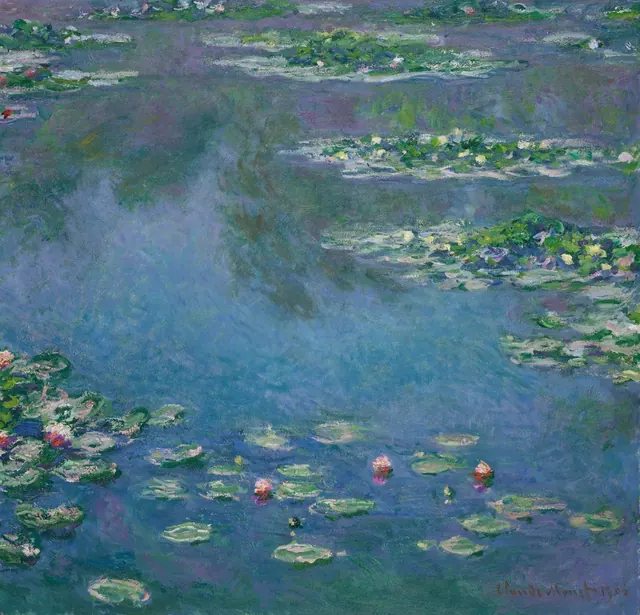
Claude Monet returned to this pond for years, having first created the pond itself. After buying his Giverny house in 1890, he established a water garden that became a lasting subject. Water Lilies of 1906 presents this familiar place without its banks or bridge. Plants, reflections and depth now share a single expanse of water.
A pink blossom near the bottom stands out in several thick strokes. Up close, separate touches of the brush remain visible; at a distance, they become petals. Monet handles the flower differently from the water around it. The shift between solid paint and unstable reflection distinguishes what floats on the surface from what appears within it.
The neighbouring flower accompanies a small group of green leaves. The arrangement changed during painting, however. Examination of the paint revealed that Monet covered some earlier foreground plants with water. The open intervals resulted from selection and revision. He could remove a plant from the picture while leaving it in the garden.
Leaves gather in a broad band entering from the left edge. They provide a nearby reference among the reflections. The nearly square canvas offers no customary panoramic direction. Our eyes cross the water through gaps between islands of greenery instead of travelling along a bank.
Lily clusters above and to the right enclose the open centre. No horizon separates sky from land. This arrangement developed in Monet’s series after 1903. The pond gradually occupied the entire canvas, with the surrounding garden surviving chiefly as reflections.
The blue centre looks light, although its surface was extensively worked. Conservators identified as many as nine paint layers in places. The effect of a brief impression required several sessions and returns to dried passages. The water’s apparent ease emerged from prolonged work.
Dark vertical traces of reflected trees run through blue and lilac. Monet’s interest in water changing with the light demanded many canvases devoted to one motif. In 1908 he wrote to his friend Gustave Geffroy about his struggles with the pond paintings. Familiarity with a place did not eliminate doubt or revision.
In May 1909 this painting appeared in a large Water Lilies exhibition at Paul Durand-Ruel’s Paris gallery, alongside dozens of versions of the motif. One canvas invites us to pause by the pond; the series reveals how differently it could exist in paint. This human-made garden proved complex enough to occupy Monet for decades.
- Medium
- Oil on canvas
- Collection
- Art Institute of Chicago
- Dimensions
- 89.9 × 94.1 cm
- Accession number
- 1933.1157
Sources
Image provided under CC0. Image licence
Adapted and translated from Art Institute of Chicago materials. · Text licence