Las Meninas
Diego Velázquez · 1656
Explore the painting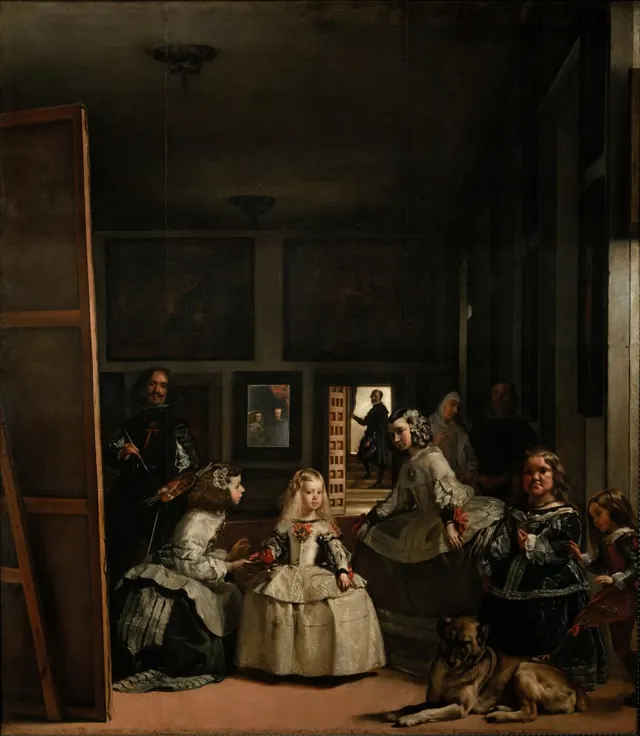
Velázquez painted Infanta Margarita and her attendants in 1656, including himself beside a large canvas. Several people look towards us, while the royal couple appears in a distant mirror. A court portrait becomes a complex scene of an artist at work.
Light falls on the Infanta and her two maids of honour. Pale and grey strokes build the child’s white dress. At a distance they resolve into folds and ornaments, though individual brushmarks remain loose close up.
The painter holds a brush and palette. His canvas faces away from us, concealing its subject. Velázquez includes both himself and the act of painting while withholding part of the scene’s information.
The mirror reflects Philip IV and Mariana of Austria. Although much smaller than the foreground figures, they are crucial to the scene. Scholars differ over precisely how their image reaches the mirror.
A large dog lies at the lower edge. People stand behind it, followed by the far wall and an open doorway. Overlapping forms and diminishing figures establish successive layers of depth.
A man stands on steps in the open doorway. The space behind him is much brighter than the room. This small opening establishes the painting’s farthest depth and prevents the dark rear wall from appearing flat.
The back of a stretched canvas occupies the left edge. It conceals part of the studio and painter. The structure’s size indicates the scale of his work, while the image on its front remains hidden.
A large dark area of the room remains above the figures. Paintings and ceiling fittings can be distinguished there. Velázquez preserves the room’s height even though almost all the activity takes place below, near the infanta’s illuminated dress.
The attendant at the left bends towards the infanta and offers her a small vessel. Her hand and head turn towards the child. Among the gazes directed out of the picture, this gesture establishes a specific action within the room.
Velázquez joins precise spatial construction with loose brushwork. Convincing details of clothing dissolve into paint at close range. Light selects parts of the room while leaving others in shadow, a characteristic device of Baroque painting.
- Medium
- Oil on canvas
- Collection
- Museo Nacional del Prado, Madrid
Sources
Public Domain. Resized previews and tiles prepared for display; no retouching or upscaling. Image licence