The Night Watch
Rembrandt van Rijn · 1642
Explore the painting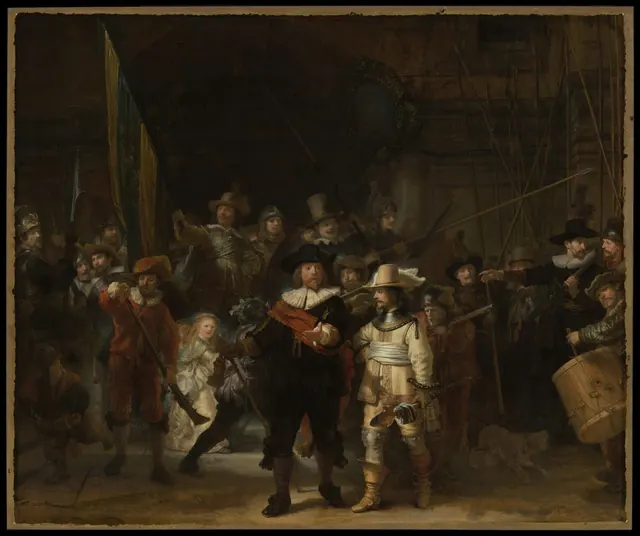
In 1642 Amsterdam’s civic guards received an enormous group portrait from Rembrandt for their meeting hall. They are preparing to move out. Captain Frans Banninck Cocq, in black, gives an order to the pale-clad Lieutenant Willem van Ruytenburch. The company presents itself through an action intended to convey its readiness to defend Amsterdam.
Individual places in the painting were paid for. In a statement of 1659, one guardsman recalled a fee of roughly one hundred guilders per man, varying with the figure’s position. The officers’ payments are unknown. Two demands coexist within the crowd: representing a united company and portraying individuals who wanted to remain recognisable.
The captain extends his hand towards us. Its shadow falls on the lieutenant’s pale clothing around Amsterdam’s embroidered coat of arms. The Rijksmuseum reads this juxtaposition as a promise to protect the city. A nearly tangible gesture acquires political meaning while remaining a convincing shadow that establishes the distance between hand and fabric.
The girl in a golden dress is nearly as brightly lit as the officers. A dead chicken with prominent claws hangs from her belt, with a pistol visible behind it. The museum links these objects to the emblems of the Kloveniers and identifies the girl as their mascot. She represents the collective identity of men who each possess an individual face.
At left the red-clad guardsman loads a musket. Near the centre another fires, while a third on the right attends to his weapon afterwards. Rembrandt distributes different stages of handling a musket across the crowd. Carefully selected actions create an impression of restless movement. The company demonstrates its occupation through recognisable tasks, carrying attention from one performer to another.
At right the drummer raises his hands over the instrument. Historian Dudok van Heel established that Jacob Joriszn earned forty guilders a year, less than half a guardsman’s typical portrait fee. He enters the gathering as someone whose work the company needed. His presence places people with very different resources beside the painting’s patrons.
The ensign raises a large banner above the heads. Its pole runs diagonally and the folds reach towards the upper edge. Below, people look in different directions, while the banner identifies them as one company. Large forms remain legible across a hall; approaching reveals individual faces. The painting works at two distances.
Gold shimmers beside lace and metal on the lieutenant’s pale costume. Researchers found nine pigments in the painted embroidery. Rembrandt applied the lightest passages thickly, so they physically rise above the surface. The luxury of the clothing is conveyed through the skill and varied materials of painting itself. This is one way of distinguishing the officer from the dark crowd.
Shafts cross above heads, barrels pass between bodies and a hand partly conceals another face. These overlaps create depth. Each person occupies a place within a crowded group where everyone cannot be equally clear. Rembrandt uses that restriction to generate movement. The eye seeks the next illuminated passage, gradually assembling the company from separate actions.
In a 2009 study, Dudok van Heel connected the hall’s series of militia portraits with a display of Amsterdam’s independence. For the city’s governors, civic guard companies helped present their own authority publicly. In this reading, the painting communicates more than the patrons’ identities. It projects a city capable of maintaining order itself. Movement, light and an armed crowd lend that promise persuasive force.
In 1715 the painting moved to the town hall and was trimmed on all four sides to fit between doors, losing most from the left. The screen shows the surviving original. A work now regarded as a national treasure was once adapted to a wall like a furnishing. Its title also came later: The Night Watch is first recorded in 1797.
- Medium
- Oil on canvas
- Collection
- Rijksmuseum, Amsterdam
- Accession number
- SK-C-5
Sources
Public Domain. Resized previews and tiles prepared for display; no retouching or upscaling. Image licence