Kitchen Scene
Diego Velázquez · 1618–20
Explore the painting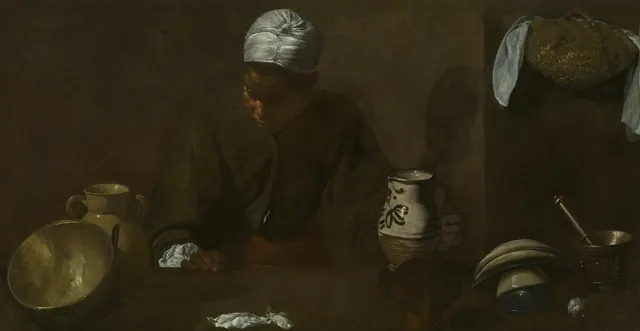
A young woman pauses at a table among jugs, bowls and kitchen tools. Velazquez painted her in Seville in 1618–20, early in his career. Such domestic pictures were called bodegones, from a word associated with a pantry. An African woman occupies the centre of a closely observed working environment. Slavery’s prevalence in Seville forms an essential part of its history.
Her lowered face lies partly in shadow. The museum proposes that an enslaved woman from the artist’s or an associate’s household may have modelled. Velazquez, his father and his teacher Francisco Pacheco all enslaved people. These circumstances connect a quiet kitchen with a society in which the sitter’s position could depend on another person’s power.
A white headwrap catches the light. Clear, substantial folds distinguish her from the dark wall while leaving the face less exposed. Light links her head with small white objects on the table, including a crumpled paper wrapper for spices.
She holds a pale jug decorated with dark foliage. Fingers grasp the handle as her elbow extends sideways. Work continues through this otherwise still gesture. Our attention passes from a human hand to precisely rendered ceramic.
A large metal bowl stands on the left. Dull reflections and signs of use cover its interior. A tall earthenware vessel reflects light differently beside it. A limited group of utensils becomes an investigation of materials while retaining practical credibility.
A pestle leans inside a mortar near the right edge, balancing the large bowl. Food preparation requires varied tools, each with weight and surface. The woman’s hand connects belongings with actions.
Stacked dishes lean at the right, their edges repeating. Simple round shapes form a complicated group of pale and dark bands. Small objects reveal conspicuous skill. A buyer could examine familiar utensils with an attention rarely afforded them during work.
A basket high on the wall expands the space above the table, with white cloth hanging from it. Weave and soft folds continue the differences of material throughout the picture. Few belongings evoke a close room where everything lies near the worker.
The bodegon brought everyday objects and a socially unprivileged model into serious painting. Artistic visibility did not imply social freedom. The woman’s possible enslavement remains a specific museum hypothesis, while Seville’s slaveholding context is established. Exceptional attention to people and things coexists with the inequality that made such observation possible.
- Medium
- Oil on canvas
- Collection
- Art Institute of Chicago
- Dimensions
- 55.9 × 104.2 cm
- Accession number
- 1935.380
Sources
Image provided under CC0. Image licence
Adapted and translated from Art Institute of Chicago materials. · Text licence