The Japanese Footbridge
Claude Monet · 1899
Explore the painting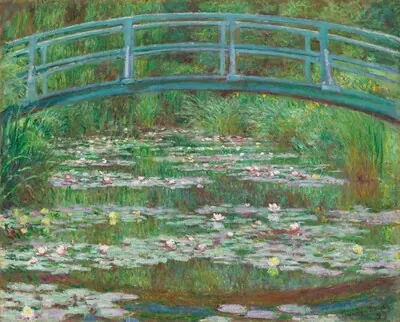
Monet designed the pond, planting, and bridge in his own water garden. In 1899 he painted twelve views from the same position. The familiar site allowed sustained attention to reflections and vegetation. He observed a landscape he had already shaped for future painting.
A blue-green bridge arches over the pond. Its curve remains clear among the many lines of vegetation.
Light lily pads gather beneath the bridge. Their horizontal patches identify the water's surface.
Pink flowers float among the pads. Small warm points remain visible within the predominantly green setting.
Tall grasses fill the left bank. Their vertical strokes differ from the pads lying flat on the water.
Reflections darken the lower water. The pond shows both its surface and the inverted vegetation around it.
The Giverny garden became Monet's sustained workplace. Returning to one position let him compare changes in light without finding another subject. In this series, designing the setting and observing it directly belong to one process.
- Medium
- oil on canvas
- Collection
- National Gallery of Art, Washington
- Dimensions
- Overall, 81.3 × 101.6 cm
- Accession number
- 1992.9.1
Sources
Reproduction of a public-domain artwork. Image licence