Self-Portrait
Vincent van Gogh · 1889
Explore the painting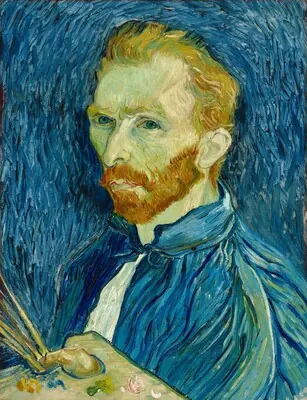
Van Gogh painted himself while recovering from a severe crisis at Saint-Rémy. This is one of his last self-portraits. Brushes and palette show him continuing to work. The vigorous marks and color relationships belong to deliberate artistic decisions considered alongside his circumstances.
Van Gogh's face turns toward the viewer. Separate colored strokes model forehead, cheekbones, and the areas around the eyes.
A rust-colored beard meets blue clothing. Warm and cool colors distinguish face from torso.
Brushes project above a small palette. The tools explicitly identify the occupation of the person portraying himself.
Curving blue strokes surround the head. The ground retains the brush's movement across its surface.
Parallel marks describe the painter's smock. Their directions follow the folds and the body's position.
Self-portraiture had been a sustained practice for Van Gogh in Paris. At Saint-Rémy he again presents himself through his profession. The palette supports that reading, while an individual brushstroke cannot by itself explain his health.
- Medium
- oil on canvas
- Collection
- National Gallery of Art, Washington
- Dimensions
- Overall, 57.79 × 44.5 cm
- Accession number
- 1998.74.5
Sources
Reproduction of a public-domain artwork. Image licence