"The Feast of Sada", Folio 22v from the Shahnama (Book of Kings) of Shah Tahmasp
Attributed to Painting attributed to Sultan Muhammad · ca. 1525
Explore the painting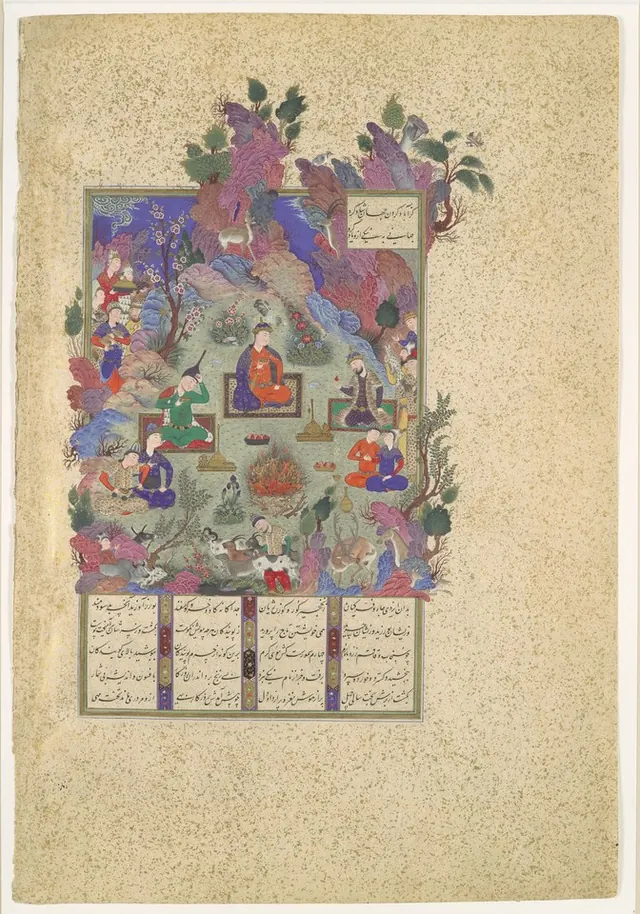
King Hushang celebrates the discovery of fire. In Firdausi’s Shahnama, he throws a stone at a dragon, misses, and strikes a rock. Sparks reveal fire’s usefulness. The miniature, made around 1525 and attributed to Sultan Muhammad, belonged to Shah Tahmasp’s luxurious manuscript, produced in the royal workshop at Tabriz.
A fire burns before the king. The painter shows the celebration rather than the stone being thrown. Red flames rise amid wood, food, and vessels. Discovery is connected immediately with practical life and a communal feast. The poem also associates Hushang’s reign with metalworking, agriculture, and irrigation.
Hushang sits on a carpet at the gathering’s center, distinguished by open space and the guests’ arrangement. The myth associates useful knowledge with kingship. For a courtly audience, it offered a ruler who brings new possibilities to his people and recognizes the value of an accidental discovery.
At the left, a green-clad participant raises a hand toward his head while refreshments arrive nearby. Others converse or hold cups. Their varied activities remain within the feast’s overall order. Sultan Muhammad’s attention to lively behavior brings small recognizable actions into the courtly ceremony.
Animals gather at the lower edge, with a person bending among them. The feast occupies a clearing within an intricately worked landscape. The distinction between the king’s principal seat and the lower group remains visible. This myth of civilization encompasses a ruler’s wider surroundings, including labor and animals.
Pink, lilac, and blue rocks rise beyond the image’s rectangle into the gold-flecked margins. A single naturalistic stone color does not govern the landscape. Form and color create a festive setting, while fine details reward close inspection of a costly book.
The Shahnama offered stories and reflection on kingship. This copy required years of skilled work and substantial resources, later becoming a diplomatic gift to an Ottoman sultan. The tale of a beneficent king thus has a material counterpart: the book displayed the wealth and cultural ambitions of the court that sponsored it.
- Medium
- Opaque watercolor, ink, silver, and gold on paper
- Collection
- The Metropolitan Museum of Art
- Dimensions
- 55.9 × 40.6 cm
- Accession number
- 1970.301.2
Sources
Image provided under CC0. Image licence