"Isfandiyar's Third Course: He Slays a Dragon", Folio 434v from the Shahnama (Book of Kings) of Shah Tahmasp
Attributed to Painting attributed to Qasim ibn 'Ali · ca. 1530
Explore the painting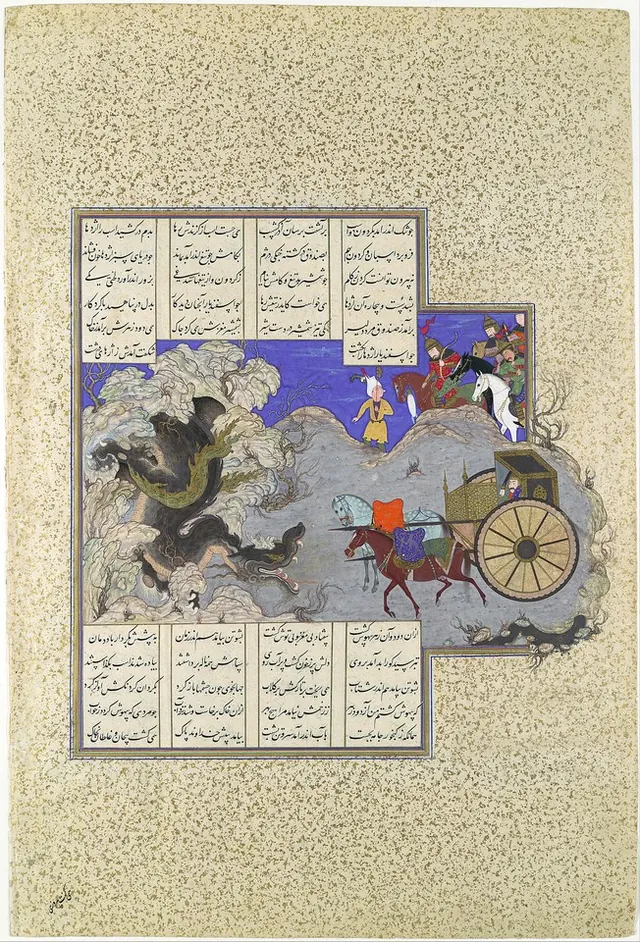
To rescue his sisters from captivity in Turan, Isfandiyar must undergo seven trials. The third is defeating a dragon. He employs an ingenious wagon fitted with sharp spears and a shelter inside. This folio, made around 1530 for Shah Tahmasp’s Shahnama and attributed to Qasim ibn Ali, shows how a trap takes the place of an open duel.
Isfandiyar shelters in a tall box on wheels, with long spearheads projecting ahead of him. In the poem, he orders the wagon built before the encounter. His advantage begins with calculation and preparation. Beside familiar signs of martial strength, a human-made machine enters the heroic story.
Horses stand before the wagon. In the story, the dragon sucks them into its mouth, drawing the spears toward itself. The device turns the creature’s own force against it. The stratagem is fatal to the animals. Heroic victory involves a sacrifice that an epic narrative can pass over quickly, while the image lets attention remain with those who bear it.
The dragon’s dark body winds among rocks, its back echoing the hillside’s turns and its mouth opening toward the team. Unlike the straight spears and edges of the wagon, its body consists almost entirely of curves. The clash between the two forces is expressed through shape before the trap’s details are understood.
Green flame appears beside the dragon’s head, sharply distinct from the surrounding blue, pink, and gold. The creature inhabits an elaborate mountain landscape requiring meticulous brushwork. The story’s danger does not make the page somber in color. A courtly reader can follow the trial while also examining a luxurious painting.
Figures on the hillside watch from a distance, occupying a different position from the hero and horses below. The painter gathers several degrees of exposure to danger within one page. A courtly viewer likewise encountered the feat from safety, while knowing its place in a longer sequence of trials undertaken by a king’s son.
The sisters’ captivity motivates the journey, although they are absent from this episode. Attention falls mainly on the hero, his adversary, and his ingenuity. That arrangement reveals an epic structure: another person’s predicament initiates the action, while glory belongs to the warrior performing the feats. Assistance to family, princely formation, and the cost of victory converge in a single adventure.
- Medium
- Opaque watercolor, ink, silver, and gold on paper
- Collection
- The Metropolitan Museum of Art
- Dimensions
- 55.9 × 40.6 cm
- Accession number
- 1970.301.51
Sources
Image provided under CC0. Image licence