Twin Pines, Level Distance
Zhao Mengfu · ca. 1310
Explore the painting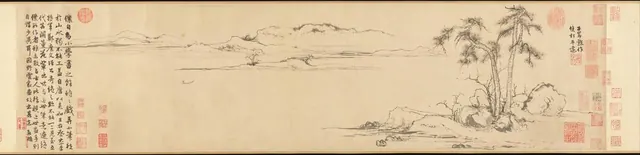
Two pines stand beside water, with low hills beyond. Zhao Mengfu painted the landscape around 1310. Descended from the Song imperial family, he entered service under the Mongol Yuan dynasty that conquered his former state. Educated contemporaries faced a difficult choice. He sought participation in a new political order while maintaining a cultural identity defined through older models of writing and painting.
Even, winding lines outline the pine trunks at the right. The museum connects them with ancient seal script. Zhao transfers a calligrapher’s control of speed and pressure into a tree. The pine remains recognizable, but writing techniques construct its appearance. A viewer trained in calligraphy could value that choice as a subject in its own right.
Ink breaks across the rocks beneath the trees, leaving pale gaps within strokes. The technique is called flying white. The brush trace matters more than a smoothly finished surface. One line shows both a rock’s contour and the hand’s passage across paper. Each landscape form preserves its maker’s action.
Detail nearly disappears beyond the water. Thin lines indicate low banks and sparse trees. A small boat at the left gives the broad pale area a human scale. The handscroll was intended to unfold gradually from right to left. After the nearby pines comes an expanse of water that changes the drawing’s density while retaining a continuous horizon.
At the left, Zhao wrote a long inscription over the distant landscape. He invokes earlier masters and connects the work with the official Dong Yeyun. The painting belongs to an exchange among educated people. Its text identifies the tradition the artist claims, while the landscape demonstrates his reworking of it. Writing and image come from a shared brush culture and invite reading together.
The title stands beside the pines at the right. In Chinese art, evergreen trees often expressed endurance. The Met proposes a connection with Zhao’s political survival and the preservation of culture under Mongol rule. This is a possible reading supported by his biography. The pines can suggest continued life after dynastic change, with endurance achieved through adjustment to altered conditions.
Serving conquerors could appear a compromise, while working with ancient models could preserve something outlasting the state. These aspects of Zhao’s life remain together. His landscape offered later painting an important example of joining writing and image. Participation in the new order accompanied an assertion of artistic continuity, explained to his peers directly on the scroll.
- Medium
- Handscroll; ink on paper
- Collection
- The Metropolitan Museum of Art
- Dimensions
- Image, 26.8 × 107.5 cm
- Accession number
- 1973.120.5
Sources
Image provided under CC0. Image licence